
To start a supper club, first find out where you're allowed to cook for paying guests, because in many places selling meals cooked in a home kitchen needs a permit, and some places don't offer one at all. Then pick a format (a set menu at one shared table, for 8 to 20 people, once a month), price each seat from your costs, fill the first dinner with friends of friends, and sell every seat in advance from a booking page. Collect each guest's email, and the people who came become the list that fills the next one.
What a supper club is
A supper club is a recurring dinner for paying guests, usually with a set menu, a small number of seats and a shared table, run by someone who isn't a restaurant, or by a restaurant on its night off. Guests book a seat for a date rather than a table for whenever, and part of the appeal is meeting the people next to you. It's the regular, ongoing cousin of the one-off pop-up dinner.
Pick a format
- Where: your home, if it's allowed where you live, or a borrowed space: a café on its closed night, a gallery, a brewery, a farm, a friend's restaurant.
- How many: as many as you can cook for and seat comfortably. Ten to twelve is plenty for a first dinner.
- How often: monthly is a good rhythm. Often enough to build regulars, not so often it takes over your life.
- The food: a set menu of three to five courses, ideally with a theme: a region, a season, a single ingredient, the food you grew up with.
- The drinks: included, sold as a pairing, bring your own, or none. This depends on the rules where you are, so read the next section first.
Check where it's legal
This step is easy to skip, and it's the one that can shut a supper club down. Before you sell a seat, ask:
- Your city or county health department (often called environmental health), whether you can cook meals for paying guests in your kitchen, what permit you need, and whether the venue you're borrowing has a kitchen that's permitted for it.
- Your state's alcohol control board or licensing office about serving drinks. Including wine in the ticket price can count as selling it, and whether guests may bring their own depends on local rules and the venue.
- An insurance broker about liability cover for guests on the premises.
- Your lease, landlord or homeowners' association, and your local zoning rules, if you're hosting at home.
California shows what a permitted home kitchen can look like. Its law lets cities and counties that choose to take part permit "microenterprise home kitchens". In Alameda County, which has opted in, the county's environmental health department issues the permit, and an operator is limited to 30 meals a day or 90 a week and $100,000 in gross annual sales. Food containing alcohol needs a license from the state's Alcohol Beverage Control department. That's from Alameda County's questions and answers on home kitchen permits, checked November 2026. Other states and counties have different rules, or none that allow it, so ask your own.
If cooking at home isn't allowed, there are other ways: rent time in a licensed commercial kitchen, cook in a restaurant on its closed night if its permits cover you, or partner with a caterer. This is general guidance, not legal advice.
Price a seat
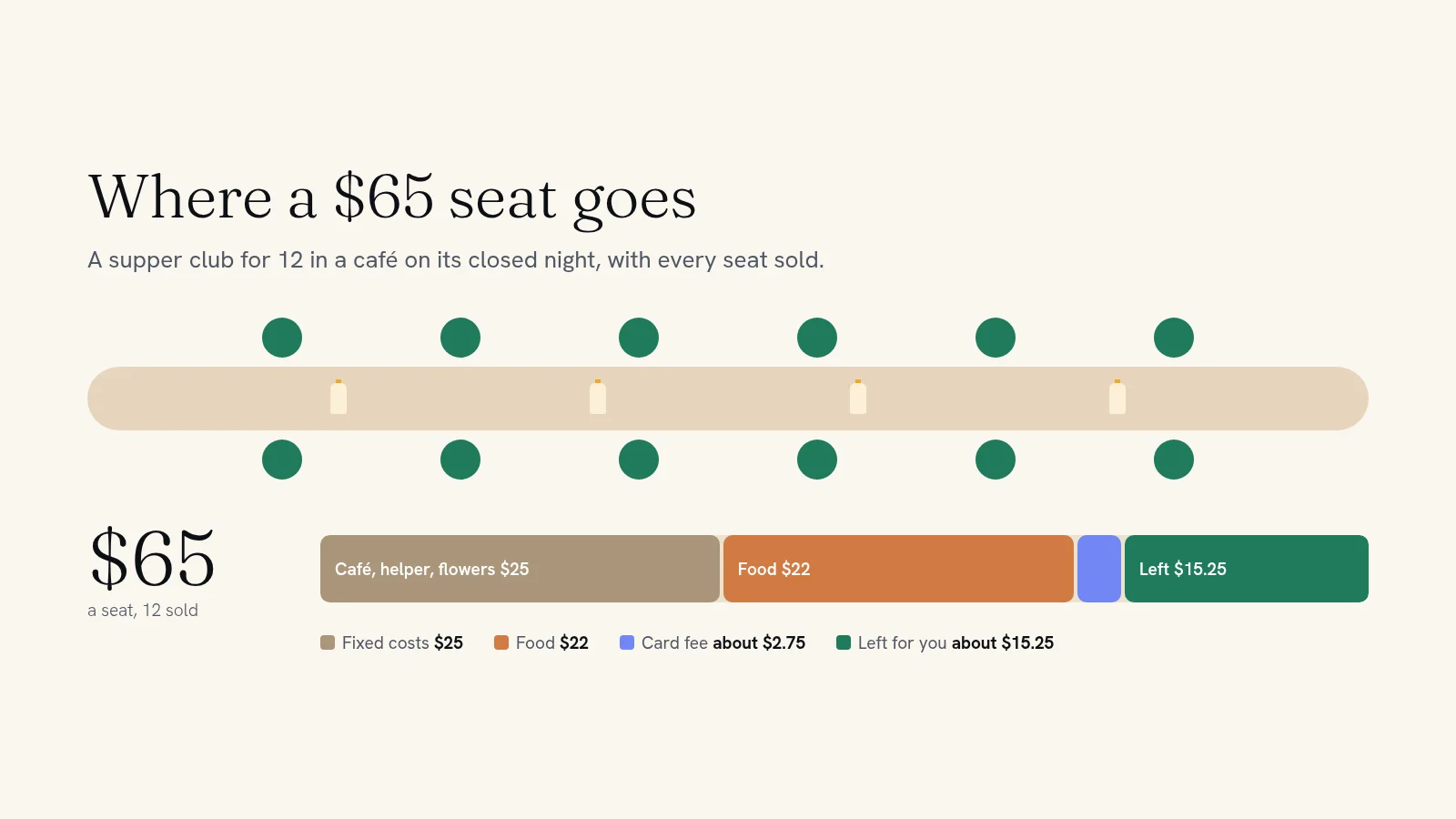
Add up what one dinner costs, decide how many seats you can count on, and set a price that covers it with something left. Say you host 12 guests in a café on its closed night:
| Supper club at $65 a seat | 10 seats sold | 12 seats sold |
|---|---|---|
| Money in | $650.00 | $780.00 |
| Café hire for the evening | $150.00 | $150.00 |
| A helper for the night | $120.00 | $120.00 |
| Flowers, candles and printed menus | $30.00 | $30.00 |
| Food, $22 a guest | $220.00 | $264.00 |
| Card fees, two seats per order | $27.45 | $32.94 |
| Left over | $102.55 | $183.06 |
This dinner covers its costs at 8 seats. When all 12 sell, each $65 seat covers $25 of the evening's fixed costs, $22 of food and about $2.75 of card fees, leaving about $15.25. If that doesn't pay you fairly for a day of shopping and cooking, raise the price or cut a cost. It's easy to undercharge at first and hard to raise prices once regulars are used to them, so start at a price you can live with.
Find your first guests
- Friends of friends for the first dinner. Not your closest friends, who'll forgive anything, but people one step out, who'll tell you the truth and tell others if it's good.
- Ask every guest to bring someone next time. A friend's invitation is hard to beat.
- Collect emails at every dinner, with permission, and announce new dates to that list first.
- Post the table, not just the food: the candles, the long table, the people. That's a big part of what people are buying.
- Work with local producers: a farm, a bakery, a winery. They may share it with their own customers.
- Invite a local food writer or newsletter once you've run a few dinners smoothly.
Sell every seat in advance
Take payment when people book. Food is bought for an exact number, and an empty seat at a table of twelve costs you money and changes the feel of the room. Make seats non-refundable but transferable, release each new date to your list a day or two before anyone else, and keep a waitlist for the dinners that fill. Collect allergies and dietary needs straight after booking, with a deadline a few days before you shop. Our guide to selling tickets for a pop-up dinner covers seat types, service charges and dietary forms in detail.
If you host at home, put only the neighborhood on the public page and send the full address in the confirmation email, so only booked guests know where you live.
On the night
- Set a start time and serve the first course within half an hour, so nobody waits hungry.
- Introduce yourself, the menu and the theme, and help guests introduce each other.
- Ask before you photograph guests, and tell them where the photos will go.
- Before people leave, tell them the next date and how to book it.
Running a supper club on Quick Elements
On Quick Elements, each dinner is an event with its own page on your web address. Set it up as a repeating monthly schedule or as chosen dates, sell seats with a set number available and a limit per order, and add a drinks pairing as an extra if you're allowed to sell it. The page shows when only a few seats are left and stops selling when the table is full. Write your own confirmation email with the full address and a link to a dietary form, and a reminder email that goes out the day before with arrival times.
Everyone who books joins your contact list, so a new date can go to past guests by newsletter before you post it anywhere. Gift cards for a seat at the table sell through the same site. Card sales cost 3.99% + 30¢ each with processing included, and nothing is added to your guest's total. The restaurant design is a quick starting point for the site.
Your first step isn't the menu. It's one phone call to your local health department to ask what you're allowed to do. Once you know, pick a date for a first dinner for ten, and see how restaurants and food businesses sell on Quick Elements.