
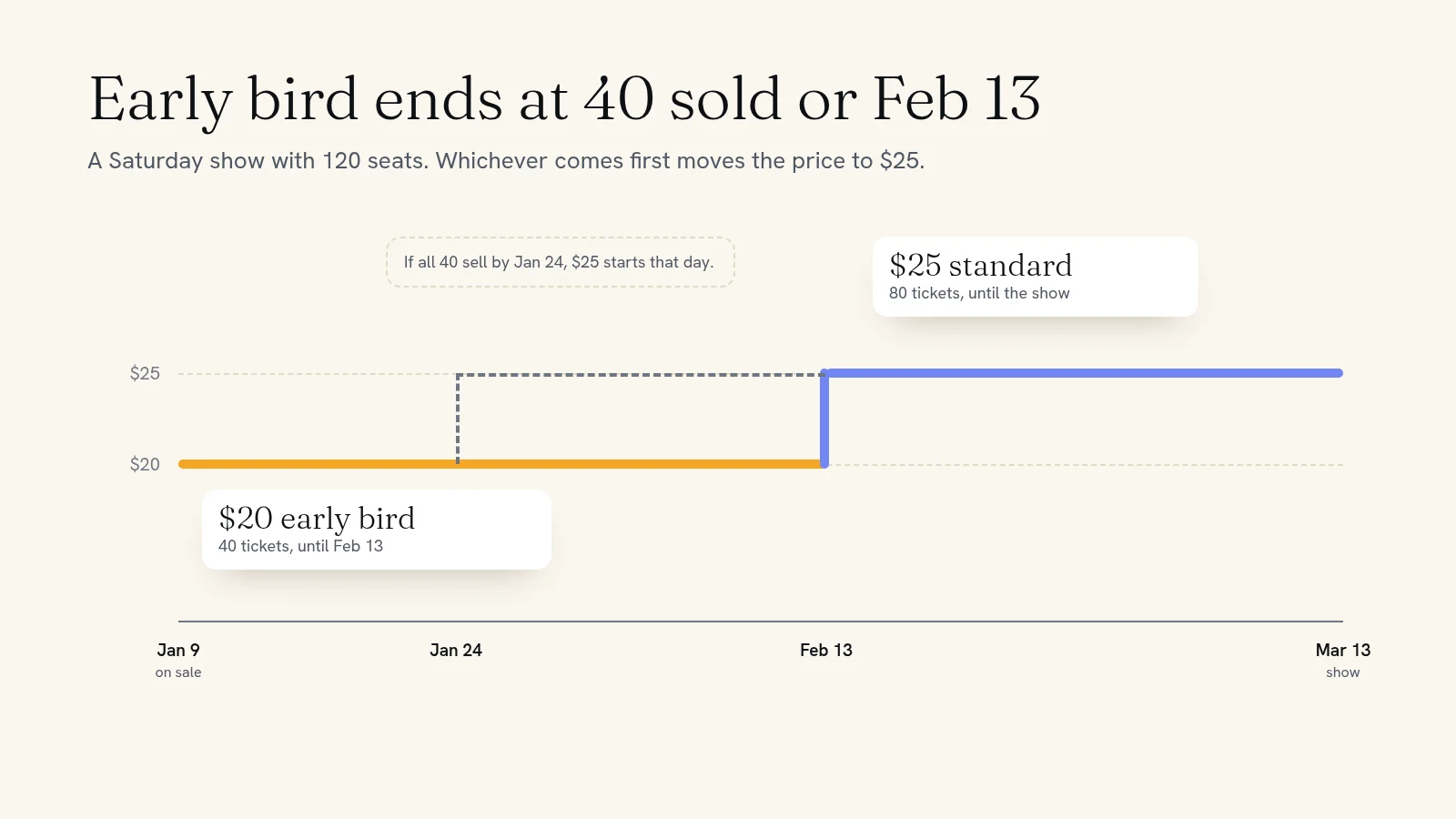
Early bird tickets are cheaper tickets for the people who buy first, available until a set number is sold or a set date passes, whichever comes first. They bring money in early, give people a reason to buy now instead of "nearer the time", and tell you early whether the event will sell. A discount of about 15 to 20% is a good starting point, and ending it four to six weeks before the event, or at a point like a lineup announcement, is a sensible default. Say on the ticket page exactly when the price ends, and don't extend it.
How early bird tickets work
There are three ways to limit them:
- By number: the first 40 tickets at the lower price. Simple, and the countdown ("8 early bird tickets left") does the selling for you.
- By date: the lower price until February 13. Fair to everyone and easy to plan around.
- Both: the first 40, or until February 13, whichever comes first. This is the safest. A slow start doesn't leave cheap tickets on sale for weeks, and a fast start doesn't sell half the room at a discount.
After the early bird comes your standard price. Some events add a third, higher price for the last weeks or at the door. Two or three steps is plenty.
What they're for
An early bird is worth its cost when it does at least one of these jobs:
- Cash before the event. Venue deposits, performers and printing are usually paid before the night. Early sales cover them.
- A reason to decide now. People who intend to come put off buying. A deadline turns "I'll get tickets later" into a purchase.
- An early read on demand. If the early birds sell in two days, you know to promote less and maybe add a date. If they barely move, you have weeks to fix the page, the price or the promotion.
If none of those matter, because the event always sells out or it's a weekly class people book a few days ahead, skip the early bird. You'd be giving money to people who would have paid full price anyway.
How big a discount
Big enough to notice, small enough that the full price still looks fair. We'd start at 15 to 20% off. On a $25 ticket, an early bird at $20 is 20% off. Here's what that costs, for a show with 120 seats and 40 early birds:
| Price | Tickets | Money in | |
|---|---|---|---|
| Early bird | $20 | 40 | $800 |
| Standard | $25 | 80 | $2,000 |
| Sold out | 120 | $2,800 |
That $200 buys you $800 in hand weeks early and a reason for people to commit. If the show wouldn't have sold out without the early push, the early bird cost you nothing at all. Go much deeper than 30% off and the standard price can start to look padded.
On cheap tickets, check what fees leave you before you discount. A fixed fee per ticket takes a bigger share of a $12 early bird than a $15 standard ticket. Try your own numbers in our ticket fee calculator.
When to end early bird pricing
- Four to six weeks before is a sensible default for evening events. It leaves several weeks at the standard price for people who plan closer to the date.
- At a milestone, such as the day you announce the headliner or the menu, so the price rises when the event gets more appealing.
- Months ahead for festivals, conferences and anything people travel to, which sell over a longer stretch.
Whatever you choose, write it on the page: "Early bird $20 until Saturday, February 13 or until 40 are sold." Email your list two or three days before the deadline, and once more on the last day. Those last-day emails only work if the deadline is real, so never extend it. The people who bought on time will notice, and next time nobody will hurry.
Early bird mistakes
- No visible deadline. A discount without an end date is just a lower price.
- Extending it. It teaches your audience that deadlines are fake.
- Too many tiers. Super early bird, early bird, advance, standard and door is four decisions too many.
- Discounting events that sell out anyway. Give regulars early access at full price instead.
- Running it on weekly classes. People book those days ahead. A standing early bird just lowers your price.
- Saying "almost gone" when it isn't. Buyers notice, and false urgency costs more trust than it earns sales.
An alternative that costs less: give your email list 48 hours of first access before tickets go on general sale, at the normal price. Your regulars get first pick, and you give nothing away.
Setting up early bird tickets on Quick Elements
There are two ways to do it, and you can use both together.
An early bird ticket type, limited by number
Add an "Early bird" ticket type at $20 with 40 available, next to a "Standard" ticket at $25 with 80 available, so the two never add up to more than the room. When the 40 are gone, the early bird stops selling by itself and the page shows when only a few are left. Keep the two counts separate rather than putting both in a shared capacity, because a shared capacity sells from one total and would let the early bird go past 40. For an event that repeats, each date gets its own 40.
A ticket type doesn't stop selling on a date by itself. On your deadline, edit the early bird and set the number available to zero, then add any it didn't sell to the standard ticket. Put the date in your own calendar so it isn't forgotten.
A discount code with an end date
If you'd rather the deadline enforce itself, create a discount code worth $5 off each ticket, with an expiry date and, if you like, a limit on how many times it can be used. Each order counts as one use, however many tickets are in it. Share the link that applies the code by itself, so buyers don't have to type anything. The code stops working on its own at the deadline. The ticket page still shows the standard price, and the discount appears at checkout.
Card sales cost 3.99% + 30¢ each with processing included, and nothing is added to your buyer's total. For setting the standard price in the first place, read how to price event tickets.
Pick your number and your date now, and write the sentence that goes on the page: "Early bird $20 until [date] or until [number] are sold." If you can't fill in both blanks, you're not ready to announce. When you are, put the event on sale from your own site.