
To price event tickets, add up what the event costs to put on, decide how many tickets you're confident of selling (not how many seats you have), and set a price where that number covers the costs with something left over. Then check it against what similar events near you charge, add at most one or two other ticket types, such as an early bird or a premium seat, and raise the price next time if you sell out early. Keep fees off the price buyers see: one clear total sells better than a cheap number that grows at checkout.
Add up what the event costs
Split costs into two kinds, because they behave differently:
- Fixed costs are the same however many people come: the room, performers or speakers, staff, equipment hire, insurance, design and promotion.
- Per-person costs grow with every ticket: food, drinks included in the price, materials, wristbands, gifts, and card fees.
Be honest about the fixed costs. Include your own time if the event is your business, and the advertising you'll actually run. An event that looks profitable on paper can lose money once the organizer's hours and the ads are counted.
Price from the tickets you can sell, not the seats you have
The mistake that loses money is dividing costs by capacity. A 100-seat room priced to break even at 100 tickets loses money at 99. Instead, pick a number you're confident of: what you sold last time, or for a first event, how many people on your list are likely to buy plus a cautious guess at newcomers.
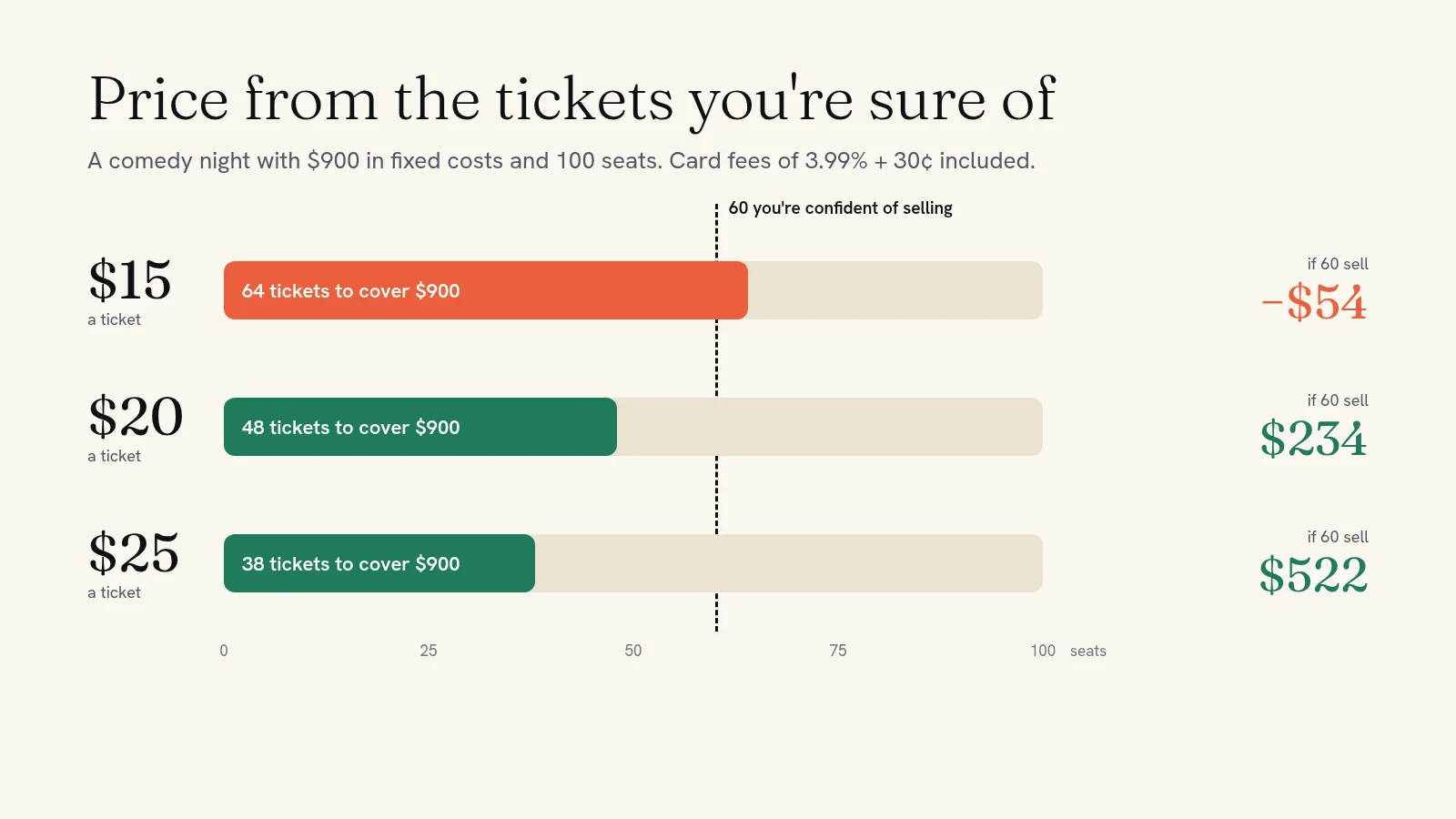
Say you run a comedy night in a 100-seat room. The room is $300, three comedians are $450, promotion is $100 and a door person is $50: $900 in fixed costs. Here's what three prices do, with card fees at Quick Elements' rate of 3.99% + 30¢ and one ticket per sale:
| Ticket price | Card fee | You keep per ticket | Tickets to cover $900 | Profit if 60 sell | Profit if 90 sell |
|---|---|---|---|---|---|
| $15 | $0.90 | $14.10 | 64 | −$54 | $369 |
| $20 | $1.10 | $18.90 | 48 | $234 | $801 |
| $25 | $1.30 | $23.70 | 38 | $522 | $1,233 |
If you're confident of 60, the $15 ticket loses money even on a decent night. At $20 you cover costs with 48 sold, well under your safe number. At $25 you'd need only 38, but you might sell fewer at that price. That's the real question pricing answers: which price leaves you safe at the number you're sure of, without putting off the people you need.
Check what similar events charge
Costs tell you the lowest price you can live with. The market tells you what people will pay. Look at five events like yours, in your area, in the last few months:
- The same kind of event, at a similar size, with a similar reputation.
- What the ticket includes: a drink, food, materials, a reserved seat.
- The price the buyer pays in the end, after any fees.
Write down the range. If you're new, the middle of the range is a safe place to start. An established name with a full mailing list can sit at the top. If your break-even price is above everything around you, change the event (a smaller room, fewer paid acts, a cheaper night of the week) before you change the price.
Choose your ticket types
One price is clearest. Add other ticket types only where they do a job:
- Early bird: a lower price for the first buyers, which brings money in early and gives everyone else a reason to buy now. Our guide to early bird tickets covers how big a discount and when to stop.
- Premium: front tables, reserved seats, a meet-and-greet or a drink included, for people who'd pay more.
- Group: a table for four or a group rate, if your crowd comes in groups.
- Concession: students, seniors or members, if that's who you want in the room.
Stop at three. Each extra choice is one more thing to decide before someone pays, and a buyer who can't decide may leave to "think about it".
Show one price that includes the fees
In the US, the FTC's rule on unfair or deceptive fees has applied to live-event tickets since May 12, 2025. Any business offering tickets to concerts, sports, theatre and other live performances must show the total price, including mandatory fees, up front and more prominently than other figures. Taxes and optional extras can be added later, as long as they're shown before payment. That's from the FTC's questions and answers on the rule, checked November 2026. This is general information, not legal advice.
Fees matter most on cheap tickets, because a fixed fee per ticket takes a bigger share of a small price. On a $10 ticket, Eventbrite's US fees of 3.7% + $1.79 per ticket plus 2.9% processing (checked November 2026) leave you $7.55 if you absorb them. Selling on your own site at 3.99% + 30¢ leaves $9.30. If your tickets are under $20, that gap decides more than any pricing trick. You can try your own prices in our ticket fee calculator, and our Eventbrite fees breakdown shows the rest of the numbers.
Free or paid?
A free ticket fills a room for a launch, a talk or a community night, but it costs nothing to skip, so plan for some empty seats. A small charge, even $5, tells you who's really coming and can go to a good cause or towards a drink. If the event must be free, ask people to book anyway so you know numbers, and send a reminder the day before.
When to raise your price
- You've sold out more than two weeks ahead, more than once.
- Your costs have gone up and your profit at a typical turnout has shrunk.
- Buyers tell you it's good value, unprompted.
Raise it for the next event, not halfway through selling the current one, and by a few dollars at a time. If a jump feels risky, add a premium ticket first and see how many people choose it.
Setting prices on Quick Elements
On a Quick Elements site, each event can sell several ticket types, each with its own price, number available per date and limit per order, and extras that can only be bought with a ticket, like a drink or a T-shirt. You can set a different price for a particular date, such as a higher Saturday price or a cheaper preview night. Card sales cost 3.99% + 30¢ each with processing included, on every plan, and nothing is added to your buyer's total, so the price on your page is the price they pay.
Before you publish your next event, fill in the cost table above with your own numbers and the turnout you're sure of. If your price doesn't work at that number, change the event, not your hopes. Then put it on sale on your own site.