
How much it costs to open an escape room depends mostly on two things: the rent where you open, and how your rooms are built. That's why nobody can give you one honest figure, and most of the "average cost" numbers online come from companies selling business plan templates rather than from operators. One price you can pin down is a ready-made room: Indestroom, which sells them, lists its turnkey rooms at €26,220 to €66,400 each, depending on the room and where it ships (Indestroom's price list, checked November 2026). For everything else, below is each cost line with the way to price it for your own town, followed by the sum that matters most: how many games a day you need to sell.
The cost lines
| Cost | What it covers | How to price it |
|---|---|---|
| Lease and fit-out | Deposit, rent, walls, power, heating and cooling, fire safety, toilets, a lobby | Square feet × local rent, plus contractor quotes |
| The rooms | Set, props, puzzles, electronics, sound and lighting | Designer and builder quotes, or a bought-in room |
| Insurance | Liability for players, your building and contents, staff | Quotes from at least three insurers |
| Staff | Game masters, resets, the front desk | Hours open × people on × local wage |
| Booking and website | Online booking, payments, your site, reminder emails | Monthly price plus the fee per sale |
| Marketing | Launch, then a monthly budget | A set amount each month, and what's free |
| Running costs | Power, repairs, replacing props that break | Your landlord's past bills and a repairs fund |
Lease and fit-out
Rent is the cost you'll live with every month, so work it out before anything else. List the space you need: each game room, a lobby where groups wait and get briefed, a control room where game masters watch, storage, and toilets. Ask a commercial agent for the asking rent per square foot per year in the areas you're looking at, and for the extra charges (property tax, building insurance and upkeep are often passed on to the tenant). Then:
Monthly rent = square feet × yearly rate per square foot ÷ 12, plus those extras.
Fit-out is where budgets go wrong. Get contractor quotes for walls, power, heating and cooling, and anything the building needs to be used by the public. Before you sign, check with your local zoning, building and fire officials that an escape room is allowed there and what they'll ask for. Exits and locks are the usual questions, because players must be able to leave a room at any moment. Rules differ by city and state, so ask them rather than relying on anyone's general guidance, including ours.
The rooms: build or buy
You can design and build your own games, with a puzzle designer, a carpenter and someone who does electronics, or buy rooms ready-made. Indestroom's turnkey rooms, at €26,220 to €66,400 each, come as a kit with props, electronics and decoration and an installation guide; its page says installation typically takes two technicians 4 to 10 days, and that the price varies with the shipping destination. Whoever you talk to, ask what the price includes: props, electronics, set dressing, shipping, installation, spare parts and support after opening.
Your own design costs less in cash and more in time, and it's the room nobody else in your city has. A bought-in room opens sooner. Many owners open with one of each.
Insurance
There's no trustworthy average for escape room insurance, because insurers price on your building, your state, your rooms and your claims history. Ask at least three for quotes, and tell each one exactly what happens in your rooms (locks, dark rooms, physical puzzles, any actors). You'll usually be asking about general liability, your property and contents, and workers' compensation once you employ staff. Your landlord's lease will often set the minimum cover too.
Staff
Every game needs someone to brief the group, watch it, give clues and reset the room afterwards. Work it out from your opening hours:
Weekly wages = hours open × people on shift × hourly wage.
Say you open five days a week, eight hours a day, with two people on. That's 80 paid hours a week, or $1,360 at $17 an hour, before payroll taxes. Check your state's minimum wage and what game masters are paid near you, and add the hours it takes to reset rooms after closing.
Booking and website
Escape room booking systems charge in one of three ways: a monthly fee, a fee per booking, or a fee added to the player's price. Our comparisons of Bookeo and FareHarbor go through two of them. On Quick Elements, plans start at $29 a month billed yearly, which covers the website, booking, a domain name and email, and card payments cost 3.99% + 30¢ per sale with processing included, so a $120 game costs $5.09 in fees.
One thing to plan for: many escape rooms ask players to sign a waiver. Quick Elements doesn't have waiver signing built into booking. You can put a form with a signature box on your site and link it from the confirmation email, which works well for most groups; if you want waivers signed and checked on a tablet at the door, budget for a separate waiver service.
Marketing
Set a launch budget and a monthly one, and decide them as numbers before you open, not as "whatever's left". Some of the most useful channels are free: a complete Google Business Profile, reviews from every group, and gift vouchers before the holidays. Our list of escape room marketing ideas has the rest.
The booking sums: how many games pay the bills
Every cost above comes back to one question: how many games a day do you need to sell? The sum is simple:
Money in each month = games a day × players per game × price per player × days open.
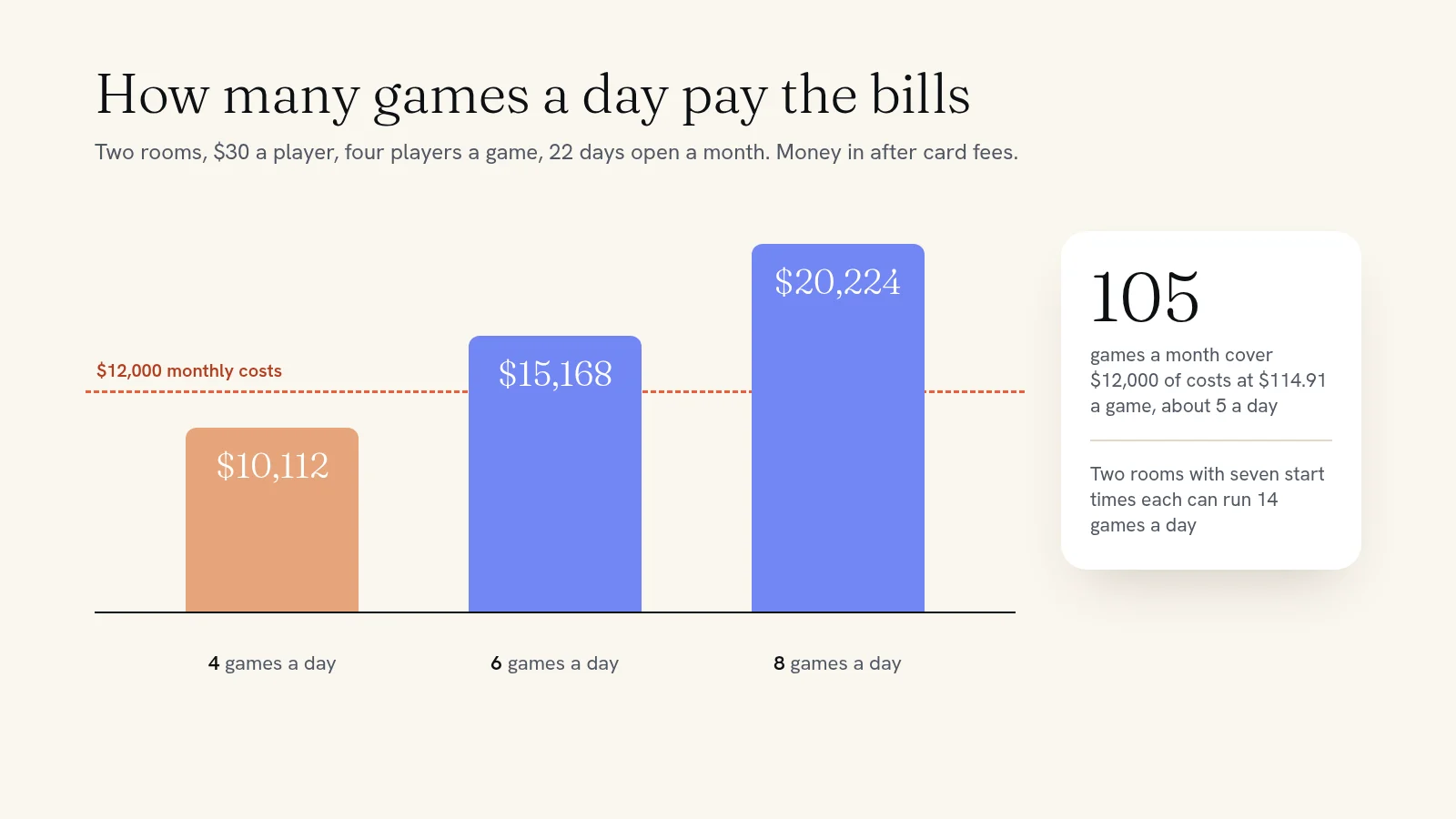
Take two rooms, open 22 days a month, at $30 a player with an average group of four. A game brings in $120, or $114.91 after card fees.
| Games a day | Games a month | Money in | After card fees |
|---|---|---|---|
| 4 | 88 | $10,560 | $10,112 |
| 6 | 132 | $15,840 | $15,168 |
| 8 | 176 | $21,120 | $20,224 |
Now divide your monthly costs by what one game leaves you. If rent, staff, insurance and everything else come to $12,000 a month, you need 105 games, about five a day, before you've paid back anything you spent to open. Two rooms with seven start times each can run 14 games a day, so five is about a third full: realistic once you're known, hard in the first months.
Three things move the answer more than anything else: your average group size (five players instead of four adds $30 a game), your weekday bookings (weekends fill first), and your price. Try your own numbers before you sign a lease, not after.
Ways to open for less
- Open with two rooms, not four, and add the third once the first two are busy on weekends.
- Lease a space that already has the toilets, lobby and power you need.
- Build one room yourself and buy one ready-made.
- Open fewer days at first, and add weekdays as bookings grow.
- Sell gift vouchers before you open, so the first months already have bookings in them.
Setting up booking on Quick Elements
On a Quick Elements site each room gets its own page with its story, difficulty and start times. Price it per player with the fewest and most players per booking, and turn on double-booking protection so a room closes to everyone else once a group books it. Add extras like a team photo, sell gift vouchers in the shop, take walk-ins and phone bookings by hand so they count against the same times, and send reminders with the waiver link before every game. The escape room design comes with two rooms set up this way: $28 and $32 a player, seven start times a day each, and an $8 team photo at the door.
Your next step
Get one rent figure and one room quote, then run the booking sums with your own prices. If the games a day you need look possible in your town, you have a business worth planning properly. When you're ready for a booking site, see how it works for escape rooms.