
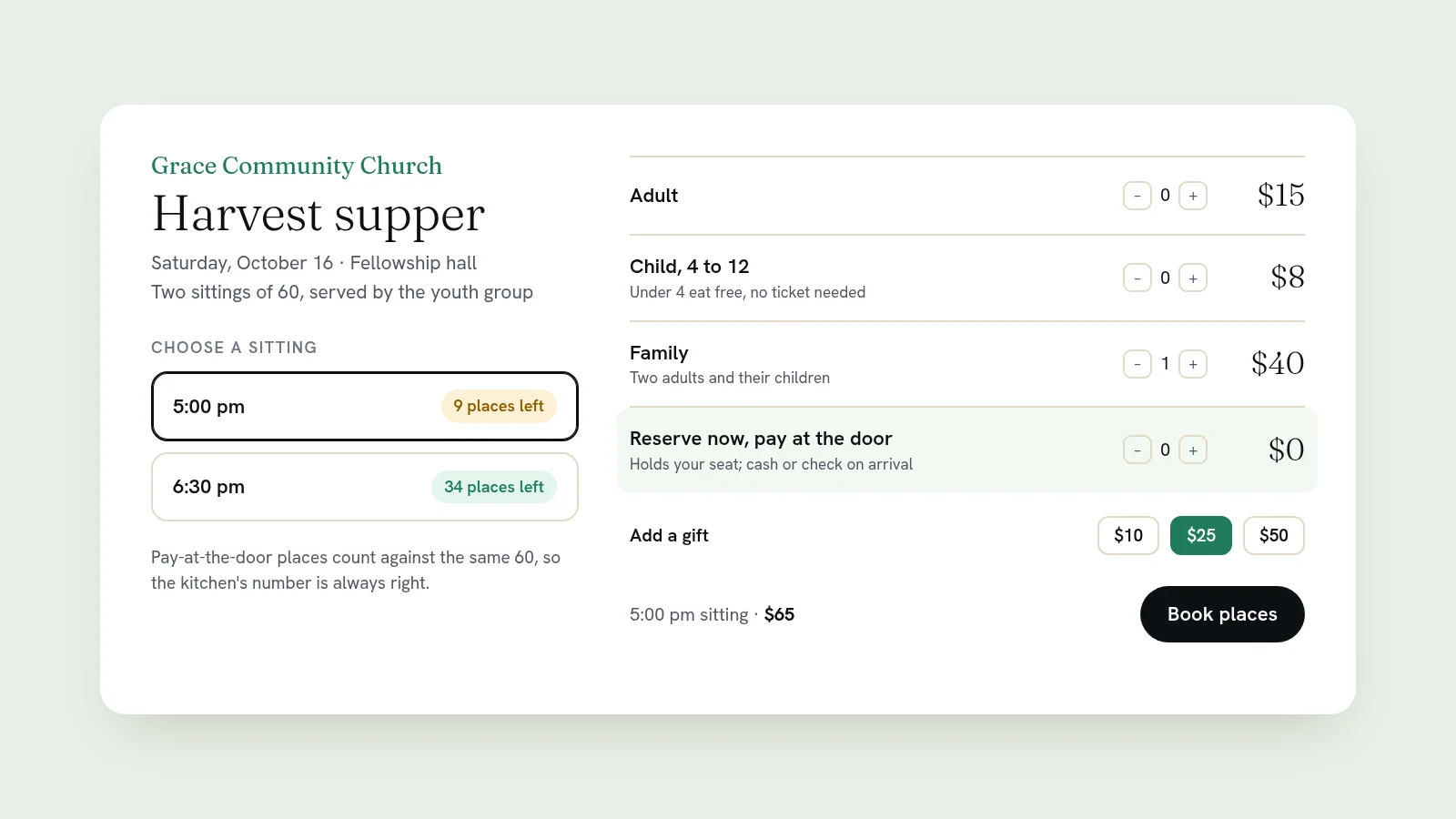
To sell tickets for a church event, first decide whether it needs paid tickets at all. Free registration suits services, studies and most concerts, and still tells you how many chairs to put out. Charge when each person costs you money, as a dinner or a retreat does. Put each event on its own page on the church's website with tickets for adults, children and families, offer a free "pay at the door" reservation for people who'd rather bring cash or a check, and let anyone add a gift as they book.
Free registration or paid tickets?
Most church events fall into one of these:
| Event | Usual approach | Why |
|---|---|---|
| Potluck, picnic, newcomers' lunch | Free registration | You need numbers for food and chairs, not money. |
| Christmas or Easter concert | Free tickets, with a gift option | Caps the room at what it safely holds; the offering does the rest. |
| Christmas Eve services | Free tickets per service time | Spreads people across the services so the 11 pm isn't overflowing while the 5 pm has room. |
| Spaghetti dinner, fish fry, pancake breakfast | Paid tickets, plus pay at the door | Each plate costs money, and many regulars pay in cash. |
| Retreat or camp | A deposit, then the balance | A big amount for families, and you pay the venue upfront. |
| Vacation Bible school, youth events | Free registration per child, plus a form | You need names, ages, allergies and a parent's phone number. |
Free registration costs nothing to run, and people who registered are more likely to come than people who meant to. If an event is free, still ask people to sign up.
Church dinners
A dinner needs a price that covers the plate and a number the kitchen can feed. Say your volunteers can serve 120, in two sittings of 60:
- Adult, $15.
- Child aged 4 to 12, $8. Under 4, free.
- Family ticket, $40, for two adults and their children.
- Reserve now, pay at the door, $0. It holds a seat and the kitchen counts it, and the guest pays on arrival.
Sell each sitting (5:00 and 6:30, say) as its own time so neither overfills. A family ticket is one ticket for several people, so decide how you'll count it against the 60: either cap family tickets at a number your kitchen can absorb, or count each one as four places when you plan the food.
Pay-at-the-door reservations are the ones that don't show. Ask people to cancel by replying to their confirmation email if plans change, and remind them two days before.
Concerts and special services
For a free concert or a busy service, a free ticket is a way to keep the room within what it safely holds, not a way to keep people out. Set the number of tickets to your seating, keep 10% for people who walk in on the night, and seat ticket holders until five minutes before the start. Offer gift amounts next to the ticket for people who'd like to give toward the music.
A concert you charge for works the same way with prices on the tickets. Most church concerts are general admission; if you'd like the front pews to cost more, sell them as their own ticket type with their own number.
Retreats and camps
A weekend retreat at $250 a person is a lot to pay in one go, and you'll owe the retreat center a deposit months ahead. Take a deposit when people sign up and the rest later:
- Make the sign-up price the deposit: "$75 deposit, balance of $175 due by March 1". Our guide to taking deposits has wording you can copy.
- Sell rooms as ticket types with their own numbers: 20 places in shared rooms, 6 private rooms at a higher price.
- Collect the balance with a second purchase. Put "Retreat balance, $175" in your shop and email the link a month before it's due.
- Gather what the organizers need (emergency contact, dietary needs, medications, and a signed release if your insurer asks for one) on a form, linked from the confirmation email. Forms can include a signature box.
For families who can't afford it, ask the pastor to hand out a discount code quietly. A code can be limited to one person's email address and to a single use, so it can't be passed around.
Paying at the door
Plenty of churchgoers would rather pay in person, and many still write checks. You can offer that without losing count:
- Sell the free "reserve now, pay at the door" ticket alongside the paid ones, so everyone is on the same list.
- Put two people on the welcome table: one with the list in name order, one with the cash box.
- Enter walk-ins as they pay, recorded as cash or check, so the kitchen's count stays true and the treasurer's totals match.
Giving on top of the ticket
Offer two or three gift amounts next to the tickets, such as $10, $25 and $50, for people who'd like to give more than the price. Gifts toward a church are often tax-deductible in the US while the dinner part of a ticket usually isn't, so ask your treasurer how to word receipts before you sell. Our guide to selling fundraiser tickets covers the receipt question in more detail. This isn't tax advice.
Set it up on your church's website
On a Quick Elements site, every event gets its own page on your church's web address, and people sign up or pay on their phone in a minute.
- Add ticket types with their own prices, including free ones, and the number of each.
- Give an event several times, for two dinner sittings or four Christmas Eve services, each with its own count.
- Add gift amounts as extras that can only be chosen with a ticket.
- Change the words to suit, so the page talks about "places" rather than "tickets".
- Write the confirmation email yourself, with parking, which door to use and a link to any form, and send a reminder two days before.
- Enter door payments and phone sign-ups by hand as cash, check or card.
Upcoming events show in a list and on a monthly calendar, and anyone can add the date to their own calendar from the event page. Free sign-ups cost nothing. Card payments cost 3.99% + 30¢ each, with card processing included and nothing added to the price people see. The nonprofit design is a good starting point for a church: it comes with free volunteer sign-ups and donation items in its shop already in place.
Start with your next event
Pick the next event on your calendar, decide free or paid using the table above, and write the three things people always ask: when, where to park and what to bring. That's your event page. When you're ready, choose a plan and put it online.