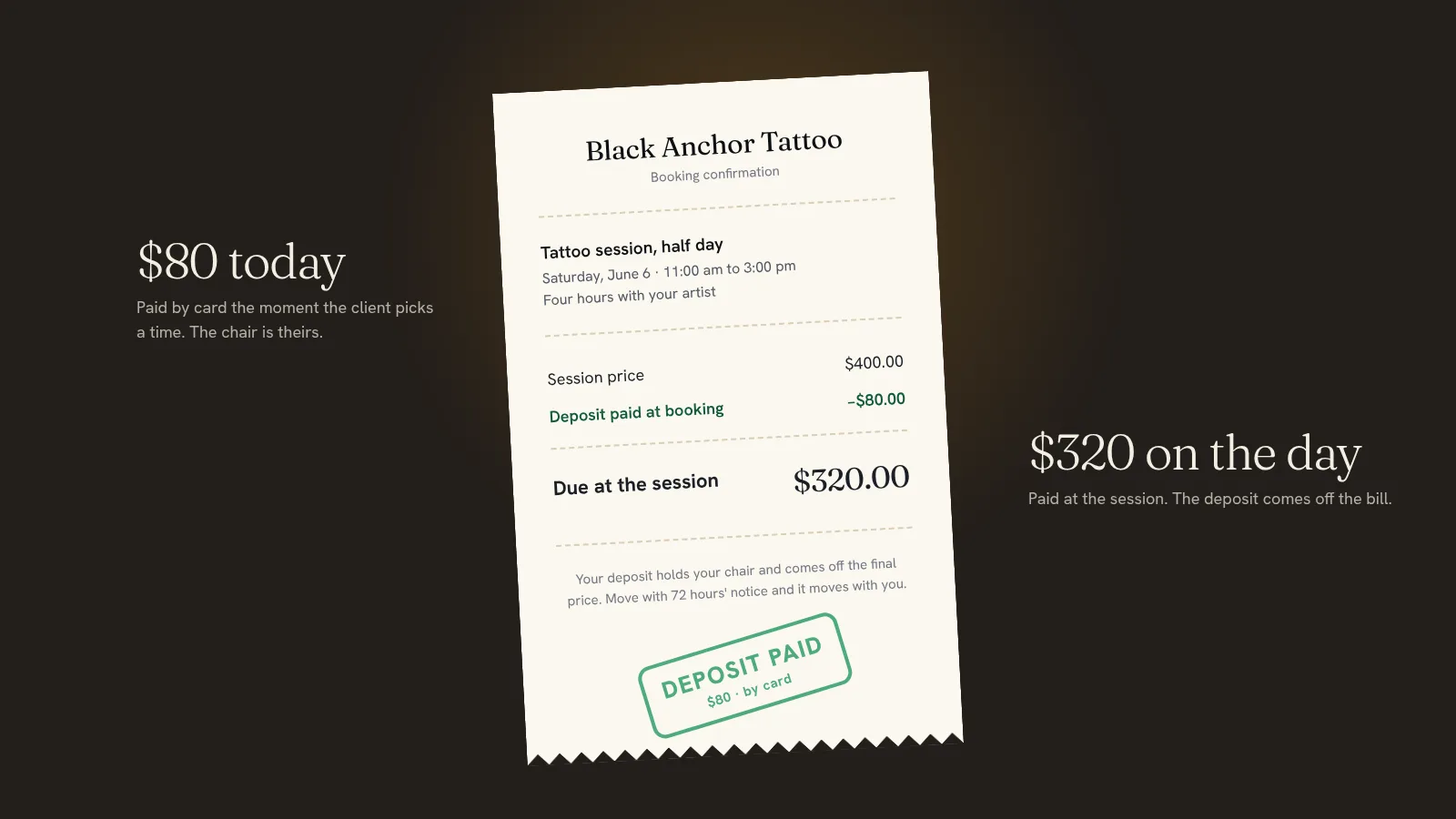
Take the deposit when the client books, online and by card, and take it off their bill on the day. For long or custom appointments, a deposit of 20% to 50% of the price, or a flat amount, is the usual range. The simplest way to do it on your own website is to make the bookable price the deposit, label it "deposit" right on the booking page, and collect the rest when the client arrives.
When to ask for a deposit
Deposits are for bookings where a gap would really hurt, or where you spend time or money before the client walks in:
- Long appointments, such as colour, extensions or a half-day tattoo.
- Custom work you prepare in advance, such as a tattoo design or a celebration cake.
- Bookings that need materials bought for that one client.
- New clients you have no history with.
- Peak times you could fill twice over.
- Group bookings and private hire.
Skip the deposit for short, low-priced services and group classes. Take the full price at booking instead; it's simpler for you and for them.
How much deposit to ask for
| Business | Common approach | Why |
|---|---|---|
| Tattoo studio | A flat amount per session, often $50 to $200 | Covers drawing time, and usually comes off the last session. |
| Hair colour and extensions | 25% to 50%, or the cost of the hair | Extensions are often ordered for one client. |
| Lashes, nails, brows | A flat $20 to $30 | Easy to explain and easy to keep. |
| Photography | 25% to 50% to hold the date | The rest is due before or on the day. |
| Private dining and parties | 25% to 50%, or a set amount per guest | Holds the room, and comes off the final bill. |
| Classes and workshops | Full payment instead | A deposit adds admin without adding much protection. |
Whatever you choose, round it to a number people remember, and make sure it at least covers what a no-show would cost you.
Refundable or not
Decide this before you take the first one, and write it next to the price.
- Non-refundable, but moves with the booking if they reschedule with enough notice. Good for custom work.
- Refundable with notice, and kept if they cancel late or don't arrive. Good for salons and spas.
- Always comes off the final bill. Say so plainly, or clients will wonder if it's an extra charge.
Our guide to writing a cancellation policy has deposit wording you can copy.
Three ways to collect a deposit online
1. Make the booking price the deposit
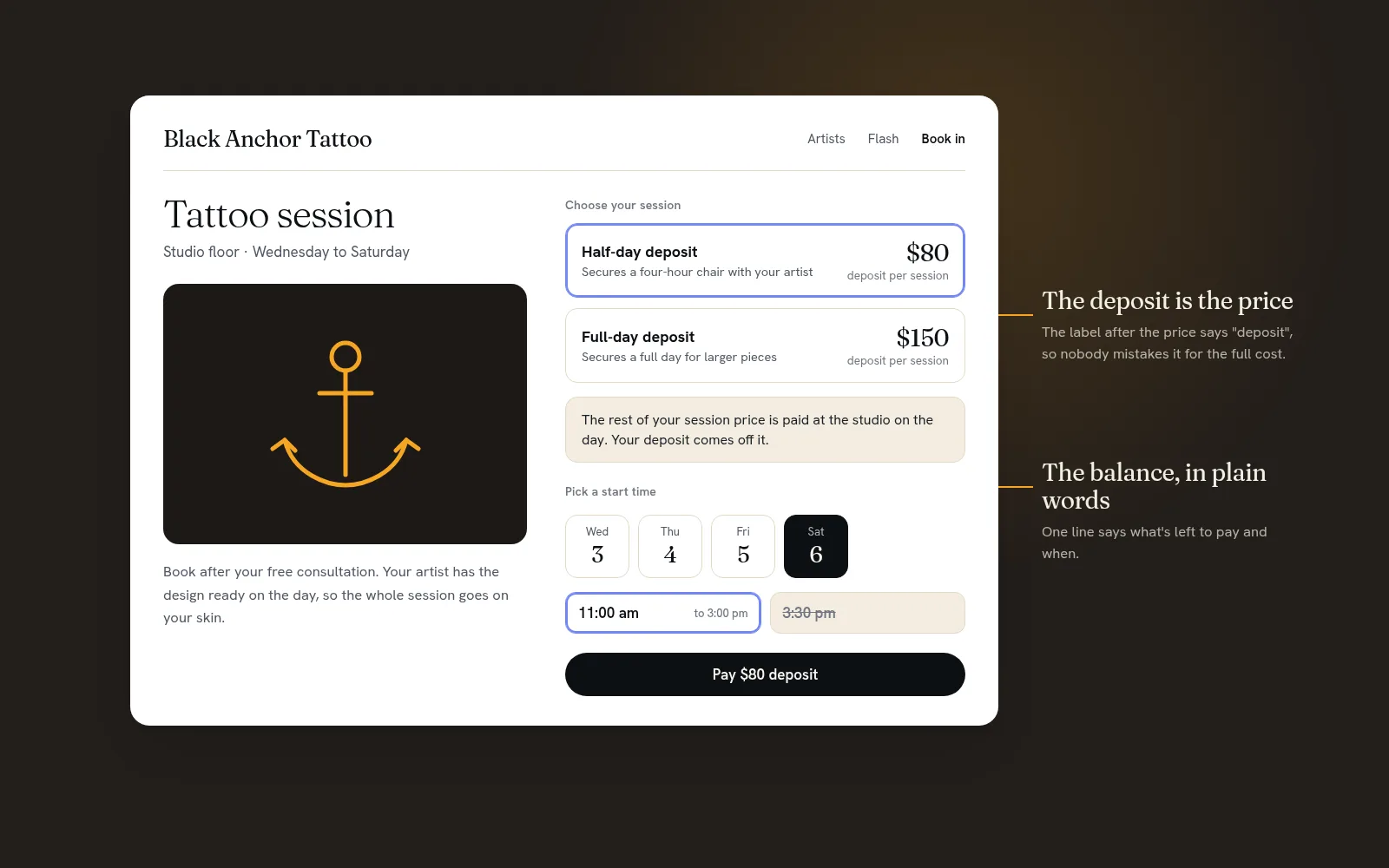
Set what people pay when they book to the deposit amount, label it clearly, and take the balance in person. It's the easiest way to start, and it works with any booking page that takes card payments. The tattoo studio design we ship works exactly like this: an $80 half-day deposit secures a four-hour chair with your artist, and the client pays the rest at the session.
On Quick Elements, each booking option has a price with a short label after it, so the booking page can read "$80 deposit per session", and the description underneath can say what's left to pay on the day.
2. Sell the deposit on its own
When the appointment is arranged after a conversation, such as a tattoo consultation or a new patient visit, sell the deposit as an item in your shop and book the time once it's paid. The dentist design sells a $95 new patient deposit that's credited toward the first visit, and the tattoo design sells a deposit that holds a flash design until the consultation.
3. Booking software that charges the balance later
Some appointment apps keep the client's card on file and can charge a late cancellation or no-show fee to it afterwards. Square Appointments, for example, lists cancellation fees and no-show protection on its Plus plan at $49 a month per location (checked November 2026). Expect that monthly fee on top of your website. Quick Elements doesn't charge a saved card later; with it, the deposit is taken at booking and the balance is paid on the day.
How to word a deposit
Say three things: how much, what it does, and what happens next.
A $50 deposit secures your appointment and comes off your final bill. The rest is paid at the salon. If you cancel at least 48 hours before, we'll refund your deposit; after that, it's kept.
Put the short version on the booking page and the full version in your confirmation email. In the reminder, add the amount still to pay, so nobody gets a surprise at the till.
What a deposit costs to collect
On Quick Elements, card payments are 3.99% + 30¢ per sale with card processing included, the same on every plan. On an $80 deposit that's $3.49, and the money goes to your bank. Whatever you take in person on the day is charged by however you take payment at the desk.
If the client cancels
Follow your policy. If they're owed the deposit back, refund it from the order. Quick Elements lets you refund all of it or part of it, and you choose whether the time goes back on sale. If they move with enough notice, move the booking to the new time from your list of who's booked, and the deposit stays with it. For more ways to protect your diary, see how to reduce no-shows.
Deposit questions owners ask
Will a deposit put new clients off?
Some people will book elsewhere rather than pay upfront, and those are often the people most likely not to turn up. Clear wording does most of the work: when the deposit comes off the bill and you say exactly when it's refunded, it reads as fair rather than suspicious. If you're nervous, start with deposits on your longest appointments only and see what happens.
Should consultations need a deposit?
Usually not. Keep a short consultation free so people can meet you, then take the deposit when they book the real thing. The tattoo studio design does this: consultations are free to book, and the session is booked with a deposit.
Can I take a deposit for a group?
Yes. Make the bookable price a deposit per person, and set a minimum per booking so a group booking always covers at least your smallest worthwhile group. A party of eight paying $25 each has $200 down before the day.
Can I charge a non-refundable deposit?
In many places you can, as long as it's stated clearly before the client pays and it's in proportion to what you lose when they cancel. Rules differ between countries and states, so check yours if you're unsure. This is general guidance, not legal advice.
Take deposits on your own booking page
With Quick Elements, the deposit is the price on your booking page. Clients pick a time, pay by card, and get a confirmation and a reminder email without you sending a thing. The tattoo studio design is set up exactly this way, and any other design can be changed to work like it in a few minutes. See plans.