
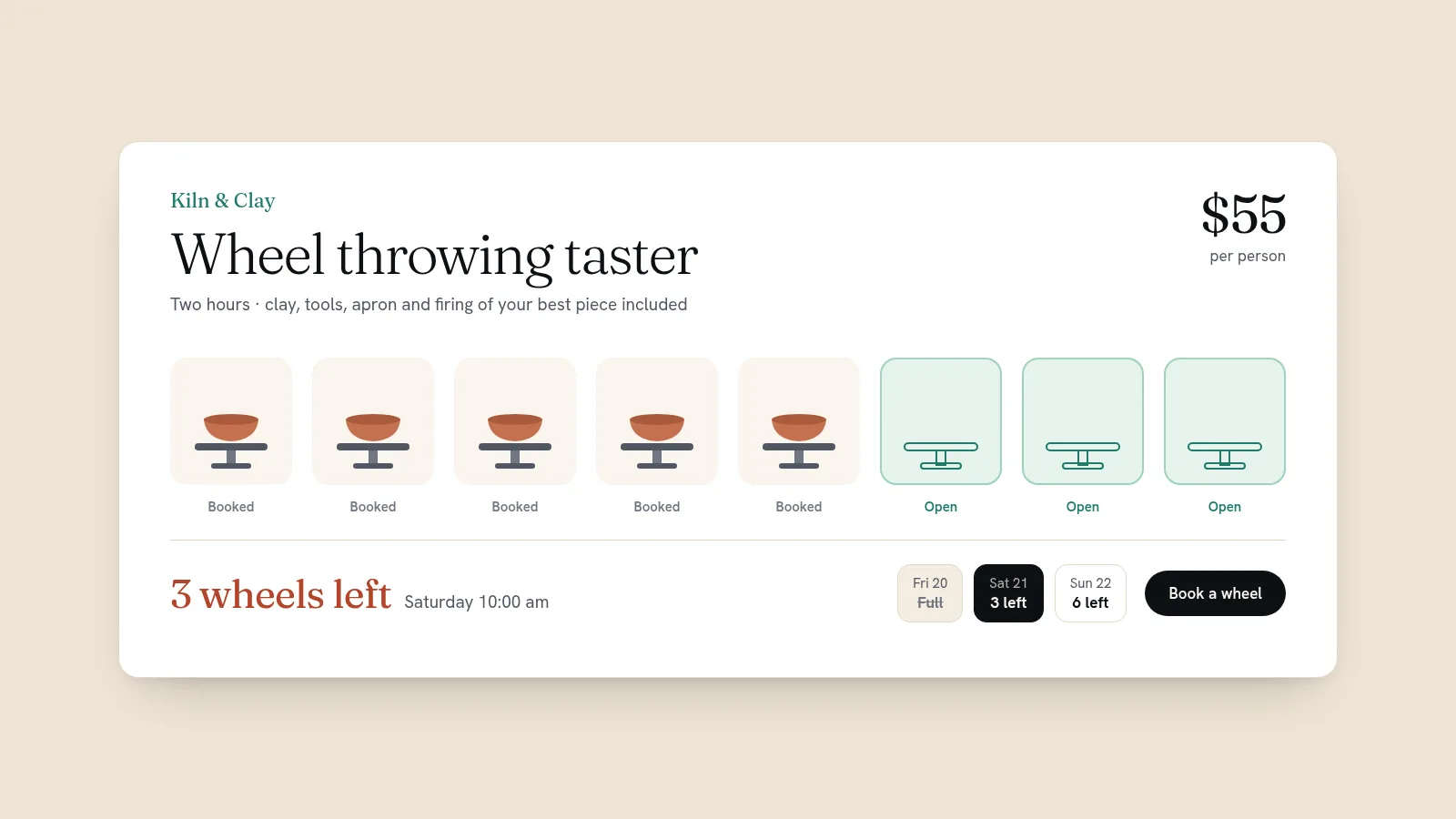
To sell workshops online, give each one its own page with the date, what people will make, what's included, the price and the places left, and take full payment when people book. Cap places at what your room and equipment can handle, put dates on sale four to eight weeks ahead, and tell your past students first. Everything below works for pottery, cooking, painting, floristry, woodwork and any other hands-on class.
Plan it around your room and kit
Your room sets your group size: the number of wheels, benches, hobs or easels you have, minus any you need to demonstrate on. Eight wheels means eight places. Then decide:
- The format: a one-off, a taster that repeats every week, or a course over several weeks.
- The length, including setup and cleaning down.
- Who it's for: complete beginners, improvers, a child with a grown-up, or private groups.
- What's included, what people take home, and when. If pieces need firing or drying, say when they'll be ready to collect.
Price it so every session pays
Add up what one session costs to run, then work out how many places you need to sell to cover it. Take a two-hour pottery taster at $55 a place, with three places sold and with all eight:
| 3 places sold | 8 places sold | |
|---|---|---|
| Money in | $165.00 | $440.00 |
| Teacher, 2.5 hours with setup | $75.00 | $75.00 |
| Share of rent and kiln power | $40.00 | $40.00 |
| Clay, glaze and firing, $8 a person | $24.00 | $64.00 |
| Card fees, 3.99% + 30¢ a place | $7.48 | $19.96 |
| Left over | $18.52 | $241.04 |
This one breaks even at three places and makes about $241 when all eight sell. If a workshop can't cover its costs at a third full, raise the price or trim the costs before it goes on sale, not after.
Write a workshop page that sells
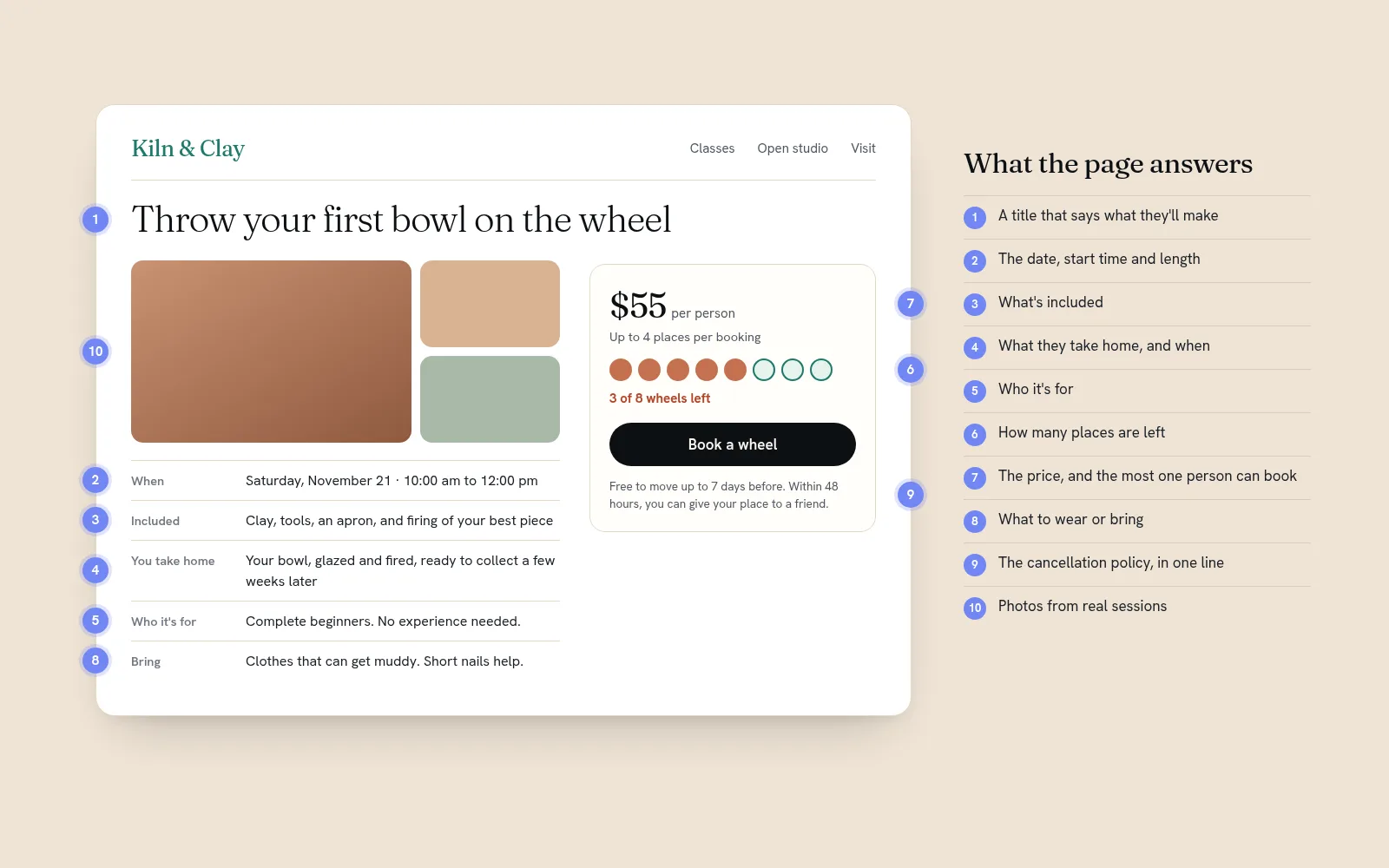
The page should answer every question someone would otherwise message you about, in roughly this order:
- A title that says what they'll make: "Throw your first bowl on the wheel", not "Ceramics session".
- The date, start time and length.
- What's included: clay, tools, apron, firing, lunch.
- What they take home, and when.
- Who it's for, and whether they need any experience.
- How many places there are, and how many are left.
- The price per person, and the most one person can book.
- What to wear or bring, plus access and parking.
- Your cancellation policy, in one line.
- Photos from real sessions: hands at work, finished pieces, the room.
Set a minimum to run, and say so
Decide before you sell how many places a workshop needs to go ahead. In the example above that's three. Put it on the page ("runs with three or more people") and check numbers at a fixed point, such as 72 hours before. If it's short, move the people who booked to another date or refund them in full, and tell them the same day. People forgive a cancelled workshop that was handled early and kindly. They don't forgive a message the night before.
The same check tells you when to add a date. If a session sells out more than two weeks ahead, open the next one straight away and email the people who missed out.
Your own website or a ticketing site
Ticketing marketplaces can bring in new people, but they take a cut of every place, and the customer ends up theirs as much as yours. Eventbrite, for example, charges US organizers 3.7% + $1.79 per paid ticket plus 2.9% payment processing (checked November 2026), which comes to $3.83 on a $55 place before processing. Selling on your own site with Quick Elements costs 3.99% + 30¢ per sale with processing included, or $2.49 on the same place, and every buyer joins your own contact list. Our Eventbrite comparison goes into the detail. If you use a marketplace to get found, invite everyone who comes back to book on your own site next time.
Set up the booking
On Quick Elements each workshop is a bookable class with its own page, and the settings follow the way workshops run:
- Repeat it weekly on the days you choose, or list specific dates for one-offs.
- Give each day its own start times.
- Set the places per session so it closes at eight, and a limit per booking so one person can't buy out the class.
- Add extras people can only buy with a place: an extra bag of clay, a glazing session, a take-home apron, lunch.
- Change the price for a single date, for a weekend premium or a cheaper preview night.
- Let two workshops share one room, so selling a place in one takes it from the other.
- Write a confirmation with what to bring, a reminder the day before, and a follow-up afterwards asking for photos or a review.
The pottery studio design comes with this already in place: a $55 wheel-throwing taster with eight wheels, five days a week, and a $22 open studio session with twelve bench places.
Different prices for different people
A workshop can sell more than one kind of place, each with its own price and limit. The kids' art class design sells a Saturday morning place at $22 and a sibling place at $18, with ten sibling places in each session. Use the same idea for a member rate, a pair ticket, or an "add a friend" place.
Private groups
For birthdays and team days, make a separate private session with a minimum per booking, so nobody books a private session for two. Set the minimum to your smallest group worth running and the maximum to the size of the room.
Questions you need answered
Cooking classes need allergies, kids' classes need a grown-up's phone number, and some activities need a signed waiver. Build a short form once, with a signature box if you need one, and put its link in your confirmation email. Answers are saved on your site, so the list is ready before the day.
Fill the last places
- Tell past students first, a few days before anyone else.
- Offer an early-booking discount with a code that ends on a set date. On Quick Elements you can share a link that applies the code by itself, which works better than a code people have to type.
- Sell private sessions for groups: birthdays, bachelorette parties, team days.
- Sell gift cards for your workshops before the holidays.
- Keep a list of people who asked about a full date, and email them when a place frees up.
- Post a photo from the last session the week before, with a link straight to the next date.
On the day
Open the list of who's booked for that date and time. If someone can't make it, move them to another date from the same list and their place goes back on sale. Take last-minute bookings by phone or at the door as manual bookings, so the numbers on your site stay right.
Sell your workshops with Quick Elements
Pick a design made for hands-on classes. The pottery studio, cooking school and kids' art class designs come with bookable sessions, places per time slot and a shop already in place. Change the details to yours, and your next workshop is on sale the day your site goes live. See how it fits craft studios, or pick a plan.