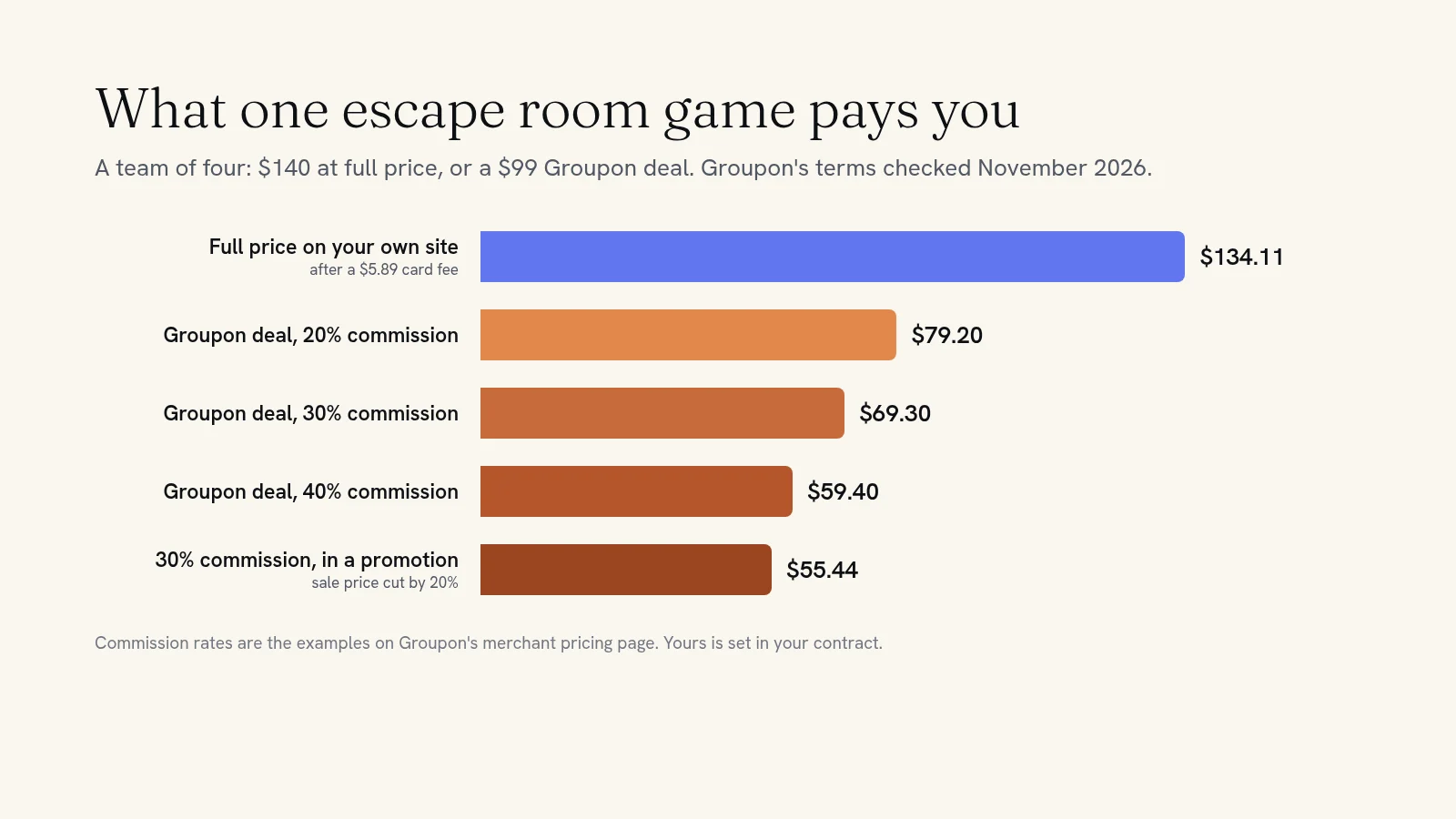
Groupon can be worth it for a small business, but only for places you'd otherwise leave empty. As of November 2026, Groupon charges no setup or listing fee and takes a commission only when a customer redeems a voucher. There's no standard rate: it's agreed in your contract, and Groupon's own examples use 20%, 30% and 40%. Because that commission comes off a price you've already discounted, a Groupon customer usually pays you about half what a regular one does. On a $140 escape room game sold as a $99 deal at 30% commission, you receive $69.30.
That's fine for a Tuesday afternoon slot that would have earned nothing. It's a loss on a Saturday night you'd have sold anyway. Below are Groupon's published merchant terms, the sums on a real-looking deal, and when it does make sense for classes, escape rooms, tours and experiences.
What Groupon charges merchants
- No upfront cost. No setup, listing or advertising fees, and nothing for views or clicks.
- Commission only on redemption. Groupon holds the customer's money until the voucher is used or refunded, then pays you the voucher price minus the agreed commission.
- No universal rate. Groupon says the rate depends on your industry, the discount you set, how the deal is structured and your goals. It calls the old "50% off, then half of what's left" rule a myth. Its illustrative maths on a $50 voucher pays you $40 at 20%, $35 at 30% and $30 at 40%.
- You set the deal. Price, discount, how many vouchers can sell a month, and the fine print. Bookable deals let customers choose a time slot when they buy.
- Promotional Adjustments. If Groupon features your deal in a promotion, it can cut the sale price by up to 20%, and your payout drops in proportion, by no more than 20%.
- Expired vouchers. Vouchers that expire unused are refunded to the customer by Groupon, and you aren't billed for them.
- Payment: weekly, on Wednesdays, with bank deposits arriving 3 to 5 business days later.
Sources: Groupon's merchant pricing page and its guide to payments and promotional programs, checked November 2026.
The sums on a real-looking deal
Say you run an escape room at $35 a player, so a team of four pays $140. On your own website, after a card fee of 3.99% + 30¢, you keep $134.11. Now say you list a Groupon deal at $99 for a team of up to four, about 29% off.
| One game for four | Customer pays | Taken off | You receive | Per player |
|---|---|---|---|---|
| Full price on your own site | $140.00 | $5.89 card fee | $134.11 | $33.53 |
| Groupon deal, 20% commission | $99.00 | $19.80 | $79.20 | $19.80 |
| Groupon deal, 30% commission | $99.00 | $29.70 | $69.30 | $17.33 |
| Groupon deal, 40% commission | $99.00 | $39.60 | $59.40 | $14.85 |
| 30% commission, in a 20% promotion | $79.20 | $23.76 | $55.44 | $13.86 |
At 30%, each Groupon game pays you about half of a full-price one. Your costs don't halve: the game master, the reset, the electricity and the wear on props are the same. If a game costs you $40 to run, a full-price team leaves $94.11 and a Groupon team leaves $29.30.
The same thing happens in a class. A $65 pottery taster listed at $45 pays you $31.50 at 30% commission. Take off $8 of clay and firing, and the place is worth $23.50 against $54.11 at full price on your own site.
When Groupon is worth it
Groupon makes sense when three things are true:
- The slot would otherwise be empty. A weekday afternoon that never sells is worth $69.30 more with a Groupon team in it. Use bookable deals and a monthly voucher cap to keep Groupon customers in those slots.
- Each extra customer costs you little. An escape room, a tour with spare seats or a class with an empty easel cost almost nothing more to fill. A cooking class with $20 of ingredients a head, or a private session that ties up a staff member, may not cover its costs.
- You have a way to bring them back. The value of a Groupon customer is the second visit at full price. If you collect their email when they book, invite them back with a reason to return, and some of them do, the first discounted visit was marketing. If none return, it was just a cheap sale.
It's a poor fit when you're already busy, when your margins are thin, or when you're small enough that a run of discounted bookings crowds out full-price ones. Watch for one more risk: people who see your Groupon price may not want to pay full price later.
Run your own off-peak offer instead
If the goal is filling quiet slots, you can do it yourself and keep the commission. On a Quick Elements site you can set a lower price on chosen dates, so Tuesday afternoons are cheaper without touching the weekend, or create a discount code that only works on certain bookings and send it to your newsletter list. You pay 3.99% + 30¢ per card sale, card processing included, so a $99 team on your own site leaves you $94.75 instead of $69.30.
What you give up is Groupon's audience: people browsing deals who've never heard of you. If you're new and nobody knows your name yet, that reach may be worth paying for once. If your quiet slots are a pricing problem rather than an awareness problem, a weekday price on your own site does the job.
For more ideas on filling quiet nights, see escape room marketing ideas and what to do when a workshop isn't selling. The escape room design shows a site with one booking per group per time slot.
Before you sign a Groupon deal
Ask for your commission rate in writing and run your own numbers through the table above, with your real cost per session. Set a monthly voucher cap you can live with, and limit the deal to your quiet times. If the per-session figure is below what the session costs you, don't run it. If you'd rather keep the whole of every booking, see our plans and set up your own off-peak price instead.