
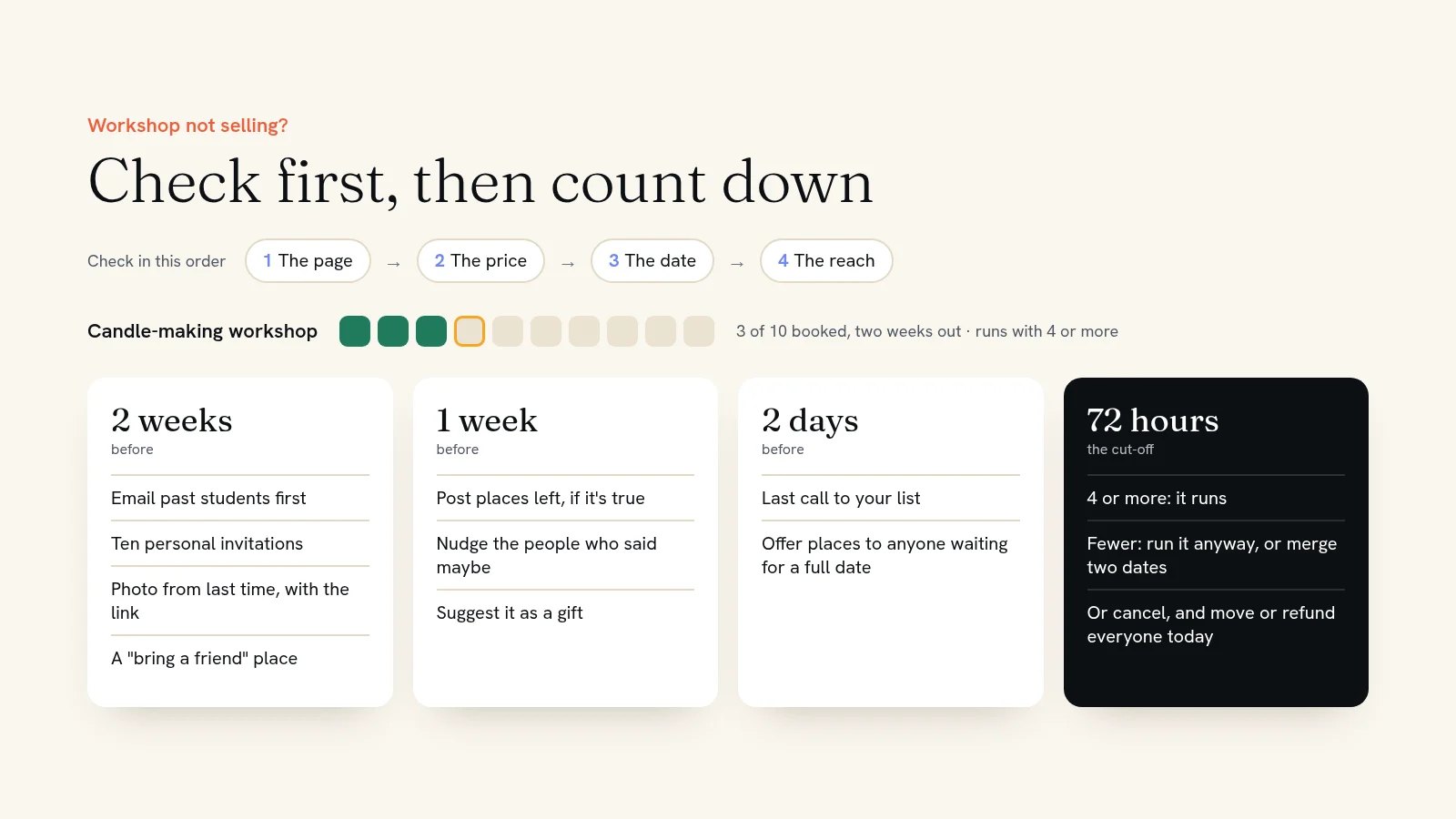
When a workshop isn't selling, check four things in this order: the page, the price, the date and the reach. Look for the one thing that's broken. Often it's simply that not enough of the right people have heard about it. Fix whichever is broken, then work through a countdown: personal invitations and your email list two weeks out, a reason to book now one week out, a last call two days out. Decide at a fixed cut-off whether the workshop runs. If it doesn't, move everyone to another date or refund them that same day.
First, find out why it's not selling
Go through these in order. The early ones are quicker to check, and there's no point promoting a page that doesn't work.
1. The page
Open your workshop page on your phone, as a stranger would, and try to book a place.
- Does the title say what people will make or do? "Make two hand-poured candles" tells people far more than "Candle workshop".
- Can you see the date, time, price and what's included without scrolling far?
- Are there photos of real people at a real session, and of finished pieces?
- Does it say who it's for, and that beginners are welcome if they are?
- Does booking take under a minute, with no surprises at checkout?
- Does every link you've shared go straight to this page, not your home page?
Then ask two friends who've never been to look at it and tell you what's unclear. They'll often spot what you can't.
2. The price
Compare it with similar workshops near you, like for like: length, group size, what's included and what people take home. If yours is higher, the page has to show why. If a three-hour workshop is a big ask for someone who's never tried the craft, a shorter, cheaper taster can be the way in. Our guide on how much to charge for a class walks through the numbers.
3. The date and time
- Does it clash with a holiday, school break, big local event or game day?
- Does the time suit the people you want? A weekday 10 am excludes most people with office jobs; a 7 pm start is hard for parents of young children.
- Was it announced with enough time? Two weeks' notice is short for a weekend workshop people need to plan around.
4. The reach
Count how many people have actually been told, not how many could have seen it. One post on Instagram and a line in a newsletter three weeks ago isn't promotion. If people who see the page book, but few people see it, the problem is reach, and the countdown below fixes it.
A quick rule of thumb: lots of questions and no bookings points to the page or price. Silence points to reach. "I'd come if it were on a Saturday" points to the date.
A countdown to fill the last places
Take a ten-place candle-making workshop with three bookings two weeks out, which needs four to run.
Two weeks out
- Email past students first, with a short personal note, not a flyer. People who've been before already know they like it.
- Invite ten people one by one by message or email: regulars, friends who said "let me know next time", people who asked about a sold-out date.
- Post a photo or short clip from the last session with a link straight to the date.
- Ask a partner to share it: the café next door, a local group, a shop that stocks your work.
- Offer a reason to bring someone, such as a "bring a friend" place at a lower price, rather than cutting the price for everyone.
One week out
- Post the places left, if the number is genuinely low: "Four places left for Saturday."
- Message the people who said maybe. A friendly "still keen for Saturday?" turns maybes into bookings.
- Suggest it as a gift for a birthday or an anniversary, with a link.
- Remind your list with one new detail, such as what's included or a photo of what they'll take home.
Two days out
- A last call to your list and on social: the date, what's included, how many places are left.
- Offer the places to anyone waiting for a sold-out date of a similar workshop.
- Decide at your cut-off whether it runs, and stick to it.
Be careful with last-minute discounts. If your regulars learn that prices drop two days before, they'll start waiting. If you do cut the price, give it privately to a small group, such as past students, rather than announcing it to everyone.
When to cancel, and how
Set a minimum number before you start selling, write it on the page ("runs with four or more"), and choose a cut-off, such as 72 hours before. At the cut-off you have three choices:
- Run it anyway, if your costs are low and you'd value the photos, reviews and goodwill.
- Merge it with another date that's also short, and offer the people booked on both a choice.
- Cancel it, and tell everyone the same day. Offer a move to another date or a full refund, their choice, and say sorry like you mean it. A small extra, such as a free add-on next time, helps.
People forgive a workshop cancelled early and kindly. They don't forgive a message the night before.
Learn for next time
Write down what sold and what didn't: the day, the time, the price, how far ahead you announced it, and where bookings came from. After a few workshops, patterns start to show, and you can stop guessing. If a date sells out more than two weeks ahead, open the next one straight away. If one keeps struggling, change the day or time before you change anything else. And keep a list of people who ask about full dates; our guide to running a waitlist shows how.
Filling workshops on Quick Elements
On Quick Elements, each workshop has its own page that shows how many places are left and stops selling when it's full. You can change the price for a single date, sell a second type of place such as a "bring a friend" place at its own price, and create discount codes that only work for certain email addresses, a set number of times, or until a date, then share a link that applies the code by itself. Every booking joins your contact list, so the next workshop can go straight to the people most likely to come, by newsletter.
If a workshop doesn't run, open its list of who's booked for that date, move each booking to another date with space, or cancel it and then refund the order in full. Moving a booking doesn't email the customer by itself, so send your own message first. For the full setup, read how to sell workshops online.
Today, open your slowest upcoming workshop on your phone and try to book it. Then send ten personal invitations before you post anything else. See how craft studios run their classes on Quick Elements.