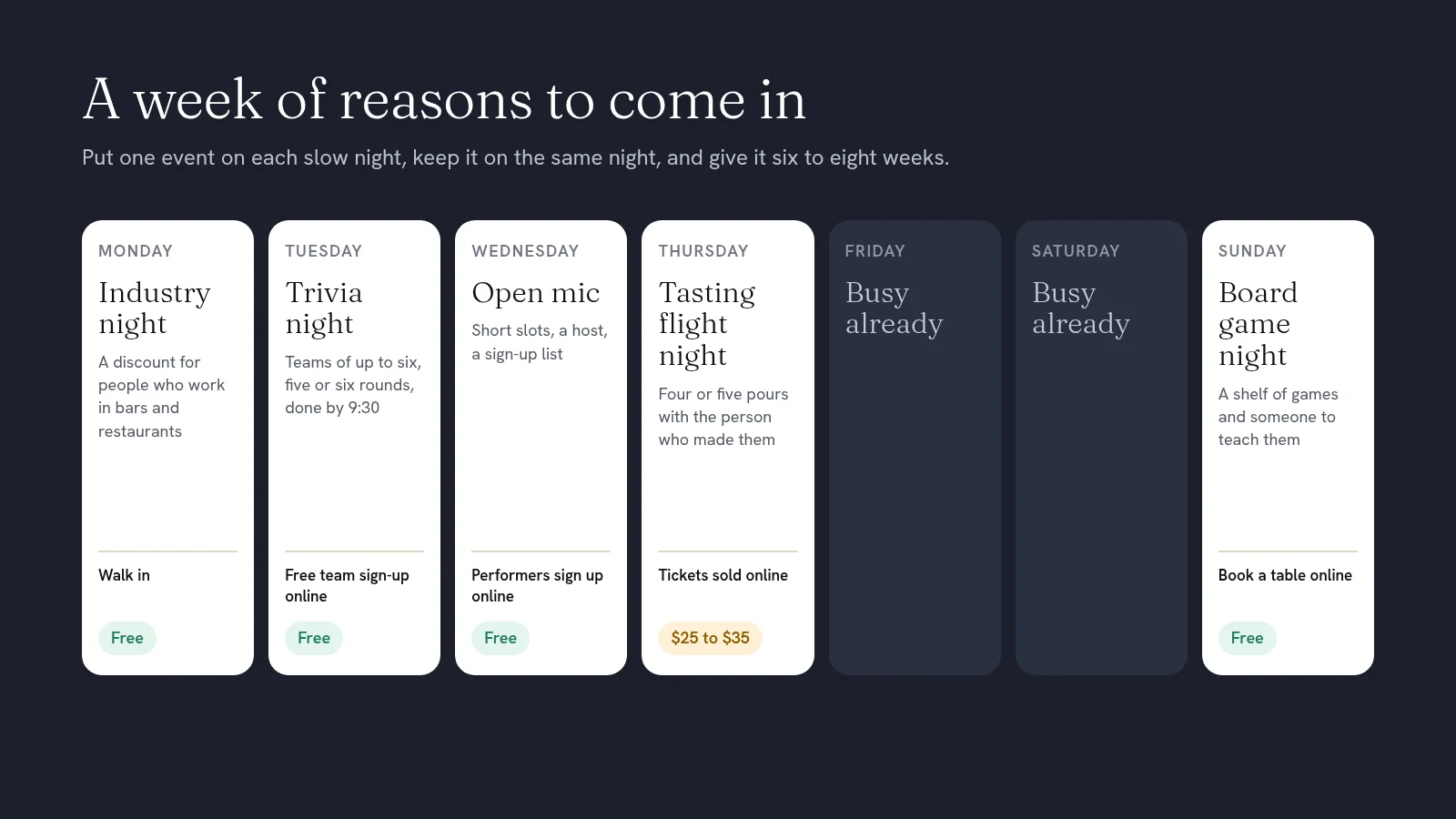
The bar events that fill slow nights give people a reason to come at a set time every week and to bring friends: a trivia night, music bingo, an open mic, a games night, a tasting, a craft night. Keep the weekly ones free to enter, because they earn their money at the bar, and sell tickets for the ones that cost you something, like a tasting or a paint night. Whatever you choose, run it on the same night for six to eight weeks before you judge it. A new night almost never fills in week one.
Here are twelve that work, what to charge, and what each needs.
Bar event ideas at a glance
| Idea | Example charge | What it needs |
|---|---|---|
| Trivia night | Free, or $5 a player for a bigger prize | A host, a mic, answer sheets |
| Music bingo | Free | Playlists, bingo cards, music licenses |
| Open mic | Free, or a small cover | A host, a sound system, a sign-up list |
| Board game night | Free | A shelf of games, someone who knows the rules |
| Tasting flight night | $25 to $35 ticket | A brewer, distiller or rep to talk |
| Paint or craft night | $35 to $45 ticket | A local artist, materials, tables |
| Comedy night | $10 cover | A host, four or five comics, a mic |
| Karaoke | Free | A host or a system, music licenses |
| Industry night | Free, with a discount | A rule for who qualifies |
| Darts or pool league | A fee per team per season | Boards or tables, a fixture list |
| Makers' market | Free to visit, a fee per stall | Space for tables, a vendor list |
| Charity night | Free, with a share of sales given | A local cause that brings its supporters |
Free weekly nights that build regulars
Trivia night
The most reliable slow-night event there is. Teams of up to six, five or six rounds, a picture round and a tiebreaker, finished by 9:30. Free entry with a bar tab for the winners is the simplest deal; $5 a player works when the prize is a cash pot people can see growing. Teams come back every week to beat each other, and that keeps the night full. Our guide to hosting a trivia night covers rounds, scoring and prizes.
Music bingo
Bingo cards with song titles instead of numbers; the host plays clips and players mark off what they recognise. Pick decades and genres that suit your crowd. It's easier to join than trivia, because nobody needs to know the answers. Playing recorded music to customers usually needs public performance licenses, so check yours cover it (more on licenses below).
Open mic
Musicians, poets and comics sign up for short slots, and every performer brings friends who buy drinks. It needs a good host and a decent sound system more than anything else. See our guide to running an open mic night.
Board game night
Buy or borrow twenty good games, put them on a shelf and have one staff member or regular who can teach the popular ones. It suits a bar with tables and a quieter crowd, and it fills the hours between after-work drinks and late night. Let groups book a table so they know they'll get one.
Karaoke
Cheap to run once you have a system, and the crowd entertains itself. A host who keeps the queue moving and gets reluctant singers up is the difference between a full room and three people singing to each other. It needs the same music licenses as music bingo.
Industry night
A discount on your quietest night for people who work in bars and restaurants, who are usually off when everyone else is out. Set a simple rule for who qualifies, and expect them to bring friends from their own crowd.
Ticketed nights that pay for themselves
Tasting flight night
Four or five pours with someone who made them talking through each one: a brewer, a distiller or a winery rep. Sell it as a ticket, $25 to $35 for example, priced to cover the drinks and a snack, and cap it at what one person can talk to. Ask your suppliers whether they'll send someone. Check your state's rules on tastings and samples before you set the size of the pours.
Paint or craft night
A local artist leads the group through a painting, a wreath, a terrarium or a candle, and everyone takes home what they made. A ticket of $35 to $45, say, can cover materials and a first drink. Agree the artist's share per ticket before you set the price, and cap places at what your tables hold.
Comedy night
A host and four or five comics, once a week or once a month. A $10 cover pays the comics, keeps the room attentive and tells people it's a show, not background noise. Seat people facing the stage and keep the bar service quiet during sets.
Nights that bring in new crowds
Darts or pool league
Teams pay a fee per season and play every week on the same night, so a league fills that night for months. Use the fee for prizes and an end-of-season party.
Makers' market
Local makers rent a table for an afternoon or evening and bring their customers with them. Free for shoppers, a fee for each stall. Our guide to taking vendor applications covers choosing and charging stallholders.
Charity night
Give a local cause a share of the night's sales and let them promote it to their supporters. They fill the room, you get new faces who might come back, and the cause gets money it needed.
Licenses and rules to check first
None of this is legal advice, and rules differ by state and city, but three things come up again and again:
- Music. In the US, music played to customers, live or recorded, is usually licensed through performing rights organizations such as ASCAP, BMI and SESAC, and it's the business that's responsible, not the band. The City of Boston's licensing office explains this plainly (Boston.gov, checked November 2026). Check what your current licenses cover before adding karaoke, music bingo or live acts.
- Drink promotions. Some states limit drink discounts and specials. Check with your state's liquor authority before you advertise one.
- Raffles and prize draws. These are regulated differently from place to place. Check before you sell raffle tickets.
Make the new night stick
- Pick your two slowest nights and try one idea on each, not five ideas on one.
- Keep the same night and time every week, so people can make it a habit.
- Tell the people already in the bar first, with a card on every table the week before.
- Count heads and bar takings each week, and give it six to eight weeks before deciding.
- Ask the regulars who come what they'd change. They'll tell you.
Take sign-ups and sell tickets on your own site
Free nights still benefit from sign-ups: you know how many tables to set, and you get an email address for next week. On a Quick Elements site each night is an event with its own page:
- Set it to repeat every Tuesday, with days off for holidays, and it stays on your calendar a year ahead.
- Use a free ticket for trivia teams, with one per order and the number of tables you have.
- Sell tasting and craft night tickets at a price, with extras like a take-home glass or a second canvas.
- Send a confirmation, a reminder on the day, and a follow-up with next week's date.
- Enter walk-ins by hand so the count stays right.
Every night shows on your events list and monthly calendar, and paid tickets cost 3.99% + 30¢ per card sale, with nothing added to the price your customers see. The arcade bar design comes with a weekly tournament night already set up: Thursdays at 7 pm, $12 a player, 32 places. Running a taproom? See how it works for breweries and taprooms.
Pick your first night
Look at last month's takings, find your slowest night, and put one idea from this list on it for the next eight weeks. Start with trivia if you're not sure: it's cheap, it works in almost any bar, and teams bring teams.