
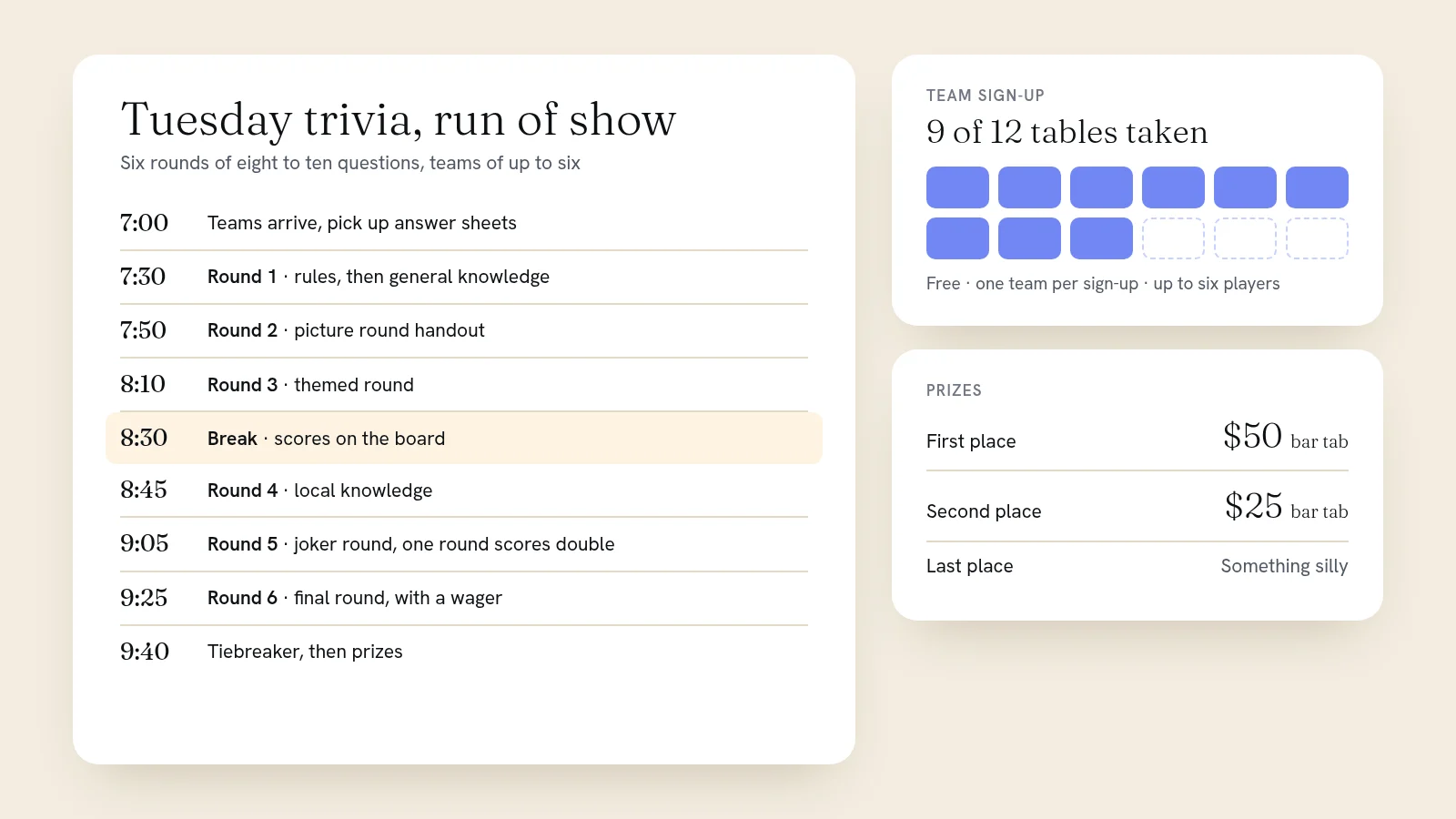
To host a trivia night, run six rounds of eight to ten questions for teams of up to six people, over about two hours. One person reads the questions and a second marks the answer sheets, so the scores are up on the board before the next round starts. Keep it free to enter at a bar, where the drinks pay for the night, or charge a few dollars a player when the prize is a pot or the night is raising money. Take team sign-ups in advance, so you know how many tables to set and who to remind next week.
The format: a two-hour run of show
A night that finishes when it says it will gets teams back the next week. This running order works for a weeknight:
| Time | What happens |
|---|---|
| 7:00 | Teams arrive, pick up answer sheets, order drinks |
| 7:30 | Rules, then round 1: general knowledge |
| 7:50 | Round 2: the picture round, on a handout |
| 8:10 | Round 3: a themed round |
| 8:30 | Break: scores on the board, the bar gets busy |
| 8:45 | Round 4: local knowledge |
| 9:05 | Round 5: the joker round, where each team picks one round to score double |
| 9:25 | Round 6: the final round, with a wager |
| 9:40 | Tiebreaker if needed, then prizes |
Eight to ten questions a round, read twice each, takes about twelve minutes. The rest is marking, scores and buying drinks, which is the point for the venue.
Writing the questions
Good questions make a night; bad ones end it early. A few rules that keep it fair:
- One right answer. "Which planet has the most moons?" has changed more than once in recent years. Avoid anything a news story could overturn.
- A spread of difficulty. Every team should get some right every round, and the best team shouldn't get them all. If nobody scores, the question was a puzzle, not trivia.
- Check every answer against two sources before the night.
- No trick questions. Players forgive hard questions. They don't forgive being misled.
- A local round. Questions about your street, your town and your bar give regulars an edge over strangers, and they love it.
Write your own or buy them in?
Writing a full night takes hours each week. Many hosts buy a weekly question pack instead. If you do, read its terms: they usually say where, how often and by whom the questions can be used, and whether you can share them afterwards. Copying questions word for word from a published quiz book or from another company's quiz means using someone else's work, so check you have permission first. Writing your own avoids the question entirely.
The music round
Playing recorded song clips to a room of customers is a public performance of that music. In the US, that's usually covered by the licenses a venue holds from performing rights organizations such as ASCAP, BMI and SESAC, and the venue, not the quiz host, is responsible for having them (City of Boston's explanation, checked November 2026). Before you add a music round, check with whoever runs the venue that its licenses cover it. Rules elsewhere differ, so check locally. This isn't legal advice.
Scoring that stays simple
- One point per correct answer. Half points for a nearly-right answer cause more arguments than they settle; decide in advance and stick to it.
- Collect answer sheets at the end of each round, and mark them while the host reads the next one.
- Read the answers out before the next round, and put the totals on a whiteboard or screen at the break and the end.
- In the final round, let teams wager up to half their points on one hard question. It keeps the teams at the bottom in the game until the end.
- Have one tiebreaker ready that needs a number, such as "In what year did the Golden Gate Bridge open?" Closest wins.
House rules to read out
- Teams of up to six.
- Phones away. A team caught looking up answers loses the round.
- Don't shout answers out.
- Late teams can join from the next round.
- The host's answer is final, and disputes go on a note to the host, not across the room.
Prizes, and whether to charge
| Setting | Entry | Prizes |
|---|---|---|
| Bar, weekly | Free | $50 bar tab for first, $25 for second, a silly prize for last |
| Bar, cash pot | $5 a player | The pot, split between the top two teams |
| Bookstore | Free | A book voucher, or the store's pick of the month |
| Café | $10 a player, with a drink and a snack | A free round of coffees next time |
| Charity quiz | $60 a team | Donated prizes; entry fees go to the cause |
A free weekly quiz earns its keep at the bar, and a prize worth winning matters more than a big one. A charity quiz is a fundraiser with a quiz in it; our guide to selling fundraiser tickets covers that side.
What you need on the night
- A microphone and speaker that reaches the back of the room.
- Answer sheets for each round, pens, and printed picture rounds.
- A whiteboard or screen for scores.
- A timer, the tiebreaker, and three spare questions in case one turns out to be wrong.
And a host who keeps it moving. Read each question twice, number them out loud, and keep jokes short. If a team disputes an answer, check it at the break rather than mid-round.
Team sign-up on your own site
Sign-ups tell you how many tables to set, and they give you each captain's email for next week's reminder. On a Quick Elements site the quiz is a weekly event with its own page:
- Set it to repeat every Tuesday at 7:30, with days off for holidays.
- For a free quiz, add a free "Team" ticket, one per order, with as many as you have tables, such as 12. The page shows when few tables are left and stops at full.
- For a paid quiz, sell a "Player" ticket at $5 with at least two and at most six per order, or a "Team" ticket at a set price.
- Booking takes the captain's name and email, but it doesn't ask for a team name. Ask for it in the confirmation email ("reply with your team name"), or link a one-question form.
- Send a reminder on the day, and a follow-up the next morning with the results and the link to next week.
- Add teams that walk in by hand, so the table count stays right.
Free sign-ups cost nothing. Paid tickets cost 3.99% + 30¢ per card sale, with nothing added to the player's price. The bookstore design and the arcade bar design both come with weekly events already on their calendars, ready to change to a quiz.
Your first quiz night
Pick your slowest night, write six rounds, and put a sign-up page up three weeks before. Tell everyone in the bar that week, and keep the same night for at least six weeks. For more ideas to fill the rest of the week, see our list of bar event ideas for slow nights.