
To run an open mic night, pick a regular night, set a slot length (two songs or eight minutes is common for music, five minutes for comedy), and take sign-ups both online and at the door. Put one good host in charge of the list, the clock and the room. You need a simple sound system with two vocal mics, a way to plug in a guitar or keyboard, and someone who knows how to run it. Keep entry free or charge a small cover, and check your music licenses first, because songs performed live by amateurs still count.
Decide the shape of the night
Before you announce anything, settle four things: the night, the start time, which acts you want, and how long each gets.
| Act | A common slot |
|---|---|
| Singer-songwriter or band | Two songs, or about eight minutes |
| Stand-up comedy | Five minutes |
| Poetry or spoken word | Two poems, or about five minutes |
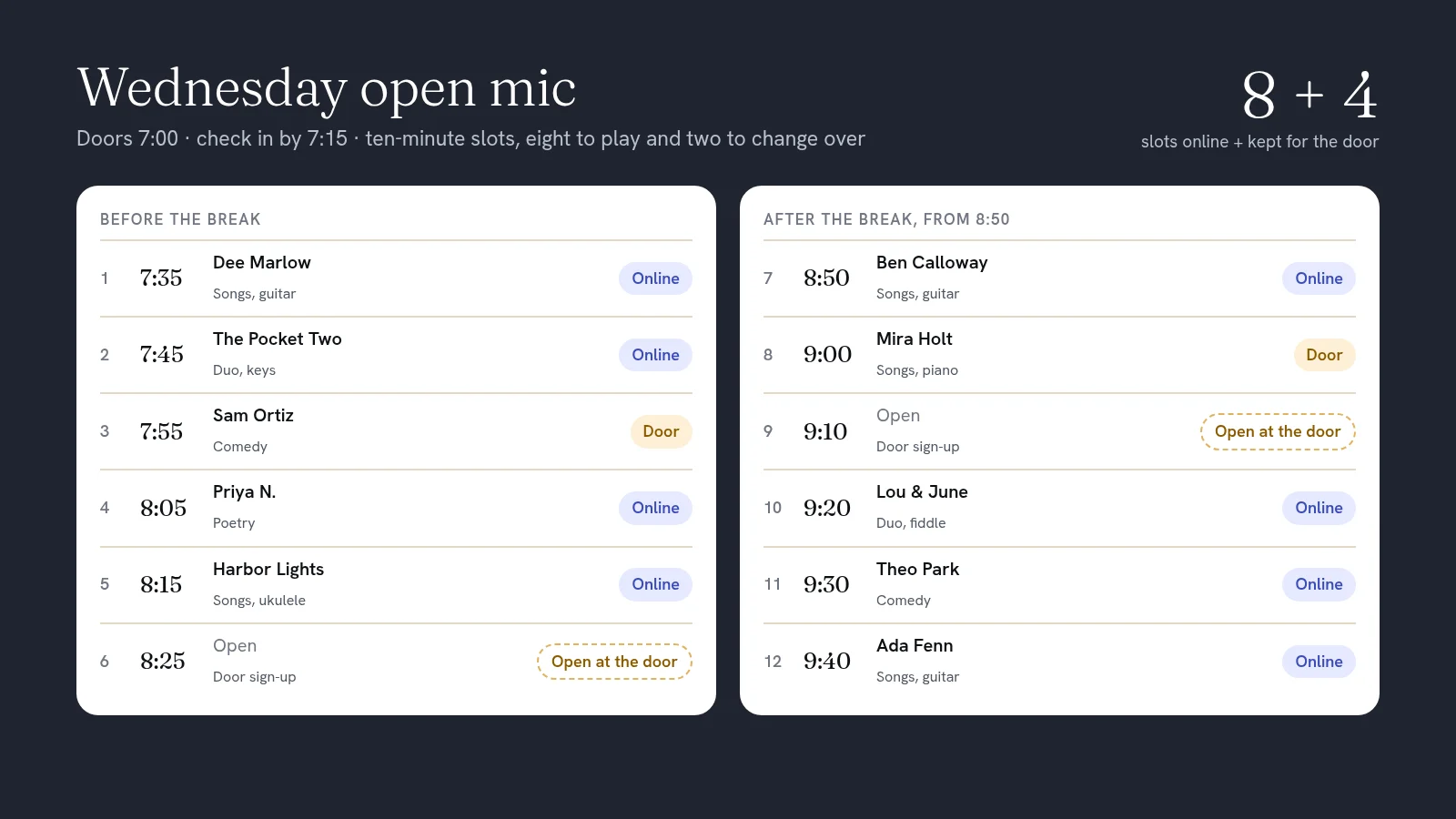
A music night with eight-minute slots and two minutes to change over gets through six acts an hour. Here's a night with twelve:
| Time | What happens |
|---|---|
| 7:00 | Doors open; performers check in with the host |
| 7:30 | The host opens with a song or a few minutes of their own |
| 7:35 to 8:35 | Slots 1 to 6, ten minutes each including changeover |
| 8:35 to 8:50 | Break |
| 8:50 to 9:50 | Slots 7 to 12 |
| 10:00 | Close |
Mixed nights, with music, comedy and poetry together, can work, but they need a host who can change the room's mood between a ballad and a punchline. Most open mics start with one kind of act and widen later.
Sign-up: online, at the door, or both
A paper list at the door is fair to whoever arrives first, but performers can't plan, and some won't travel without knowing they'll get on. An online list lets them plan, but leaves nothing for the person who walks in with a guitar. Do both: put eight of the twelve slots online and keep four for the door.
- One slot per performer per night.
- Performers check in by 7:15, or their slot goes to the door list.
- The host sets the running order, not the order of sign-up. A confident regular in the first slot warms the room up; a nervous first-timer goes on once people are listening.
The host makes or breaks it
The host's job is to make strangers feel safe getting on stage, and to keep the audience listening while they do. In practice that means:
- Introducing every act by name, and asking for applause on the way on and off.
- Keeping time kindly: a light or a small sign at seven minutes, a gentle word at nine.
- Asking the bar to keep the noise down during sets.
- Filling gaps when an act doesn't show.
Pay your host, with a fee or a bar tab. A host who's there because they want the gig turns up every week; a volunteer drifts off after a month.
Sound: what you need
- A small mixer and speakers loud enough for the room, not for a festival.
- Two vocal mics with stands, one for the voice and one for an instrument.
- A DI box and cables to plug in acoustic guitars and keyboards.
- A monitor speaker facing the performer, if you can.
- Spare batteries, a spare cable, a guitar tuner, and a chair without arms.
- One person who knows the mixer. They'll save every act from a bad sound check.
Run a line check before doors open, and keep the volume where people at the bar can still order.
Free entry or a cover charge?
| Model | How it works | Suits |
|---|---|---|
| Free for everyone | The bar earns from drinks | Bars and cafés building a new night |
| Small cover, performers free | $5 at the door pays the host and the sound person | Venues with a stage and a listening crowd |
| Free, with a paid feature act | A 20-minute set from a booked act mid-night, paid from the cover or the bar | Nights that want a reason for an audience to come |
Whatever you choose, performers bring friends, and friends buy drinks. That's why most open mics don't charge performers.
Music licenses
A cover song performed live in a bar is still a public performance of someone else's music. In the US, venues usually hold licenses from performing rights organizations such as ASCAP, BMI and SESAC, and the City of Boston's licensing office points out that it's the business that's responsible for them, not the performer (Boston.gov, checked November 2026). Some cities also need a separate entertainment license for live performance. Check both locally before your first night. This isn't legal advice.
House rules to post
- One slot each, and slots end on time.
- Check in by 7:15.
- Be kind to every act, including the ones you don't like.
- No recording a performer without asking them.
- The host has the final word on the running order.
Keep it going
- Same night, same time, every week or every month. People plan around a fixed night.
- Post photos with performers' permission, tagging them, so their friends see where they play.
- Once it's steady, add a monthly showcase for the regulars who've got good.
- Keep the performers' emails, and send the next date a week ahead.
Take sign-ups on your own site
On a Quick Elements site the open mic is a repeating event with its own page, and performers and audience can both sign up:
- Set it to repeat every Wednesday, with days off for holidays.
- Add a free "Performer slot" ticket, eight per night, one per order. When the eight are gone, the page says so.
- Add an audience ticket if you want one, free to count heads or $5 for the cover.
- Booking takes a name, email and phone, but no act name or style. Link a short form from the confirmation email for those, or ask performers to reply.
- Write the confirmation yourself ("check in with the host by 7:15"), and send a reminder on the day.
- Add door sign-ups by hand, so the list on the night is the real one.
The list of who's booked for that night is the host's starting point for the running order. The music venue design comes with weekly shows and a line-up page already in place. For comedy, see how it works for comedy clubs.
Your first open mic
Find a host, borrow or buy the sound kit, and pick a night four weeks out. Put the sign-up page up, tell every musician, poet and comic you know, and run it at least six times before you decide whether it works. If you're filling other quiet nights too, our guide to hosting a trivia night uses the same weekly sign-up.