
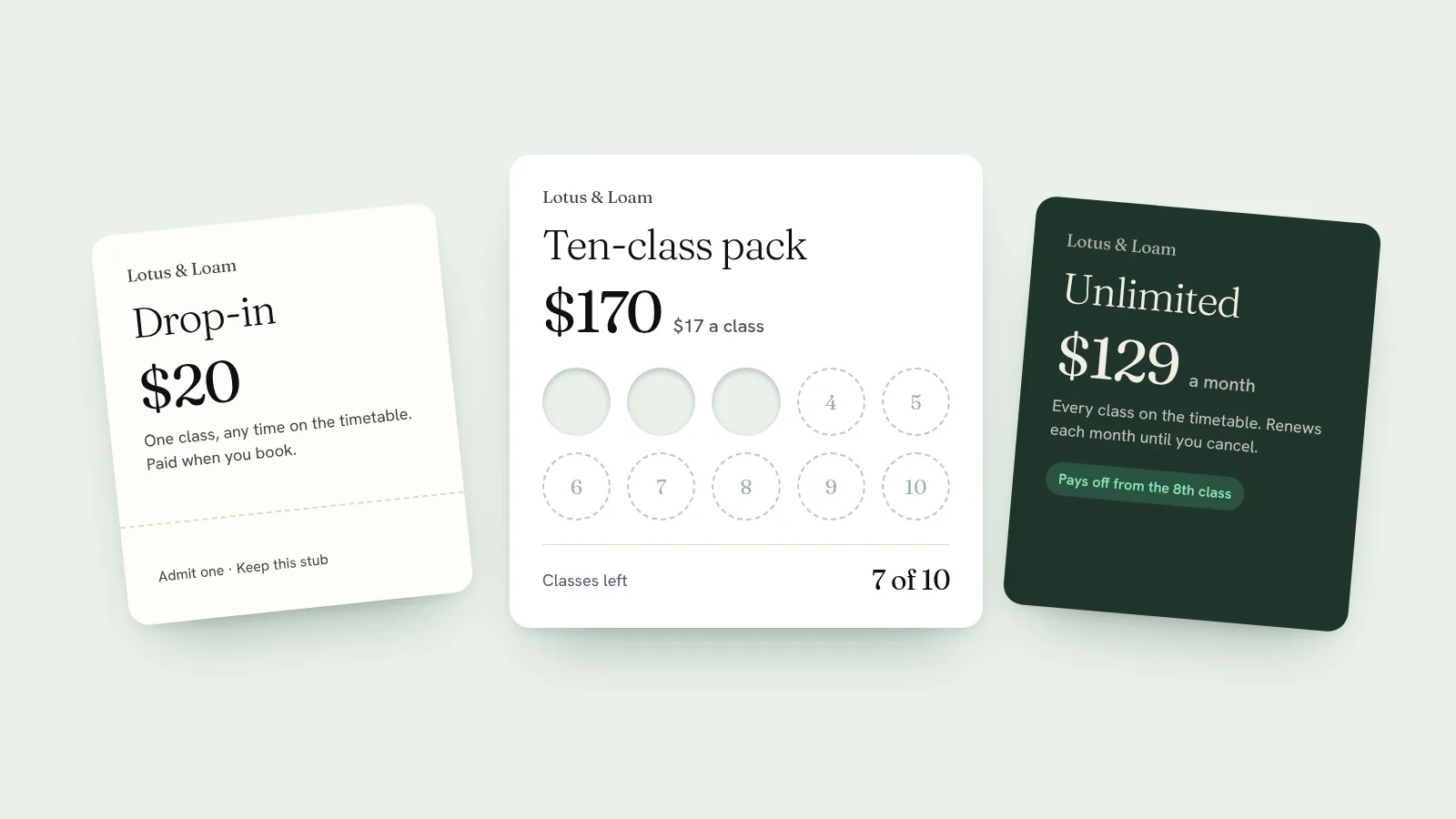
Most studios sell three things: a drop-in for people trying you out, a class pack of five or ten classes for regulars, and a monthly membership for people who come every week. Price each so the next one up is the better deal, sell them on your website with card payment, and decide before you launch how you'll keep count of classes used. That last decision is what tells you which tools you need.
The passes worth selling
| Pass | Who buys it | How it usually works |
|---|---|---|
| Intro offer | First-timers | A low price for a short window, such as two weeks unlimited. One per person. |
| Drop-in | Occasional visitors and people passing through | One class, paid when they book. |
| Class pack | Regulars whose weeks vary | 5, 10 or 20 classes at a lower price per class, used within a set time. |
| Unlimited membership | People who come twice a week or more | A monthly price that renews until they cancel. |
| Limited membership | Steady once-a-week regulars | A set number of classes each month, renewing monthly. |
Start with three: an intro offer, a drop-in, and either a pack or a membership. Each extra choice is one more thing for a nervous beginner to puzzle over. The yoga studio design we ship keeps it to that: two weeks unlimited for $39, a ten-class pack for $150, and single places at $16.
How to price class passes
Work up from your drop-in price, and make each step up worth taking. With a $20 drop-in, a sensible ladder looks like this:
| Option | Price | Cost per class |
|---|---|---|
| Drop-in | $20 | $20 |
| Five-class pack | $90 | $18 |
| Ten-class pack | $170 | $17 |
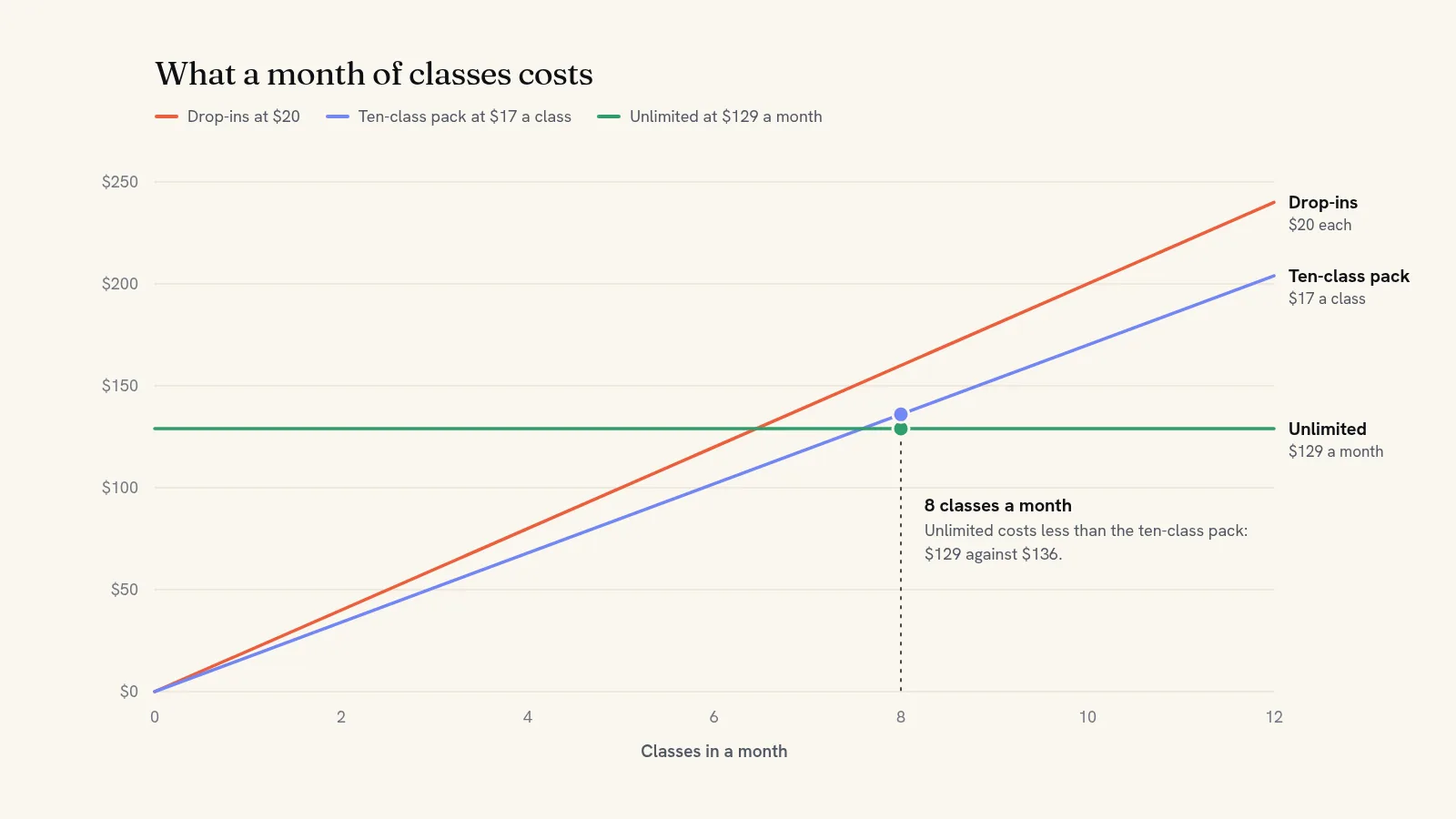
| Unlimited, monthly | $129 a month | $16.13 at 8 classes a month, $10.75 at 12 |
A few rules of thumb:
- Keep packs 10 to 20% cheaper per class than a drop-in. Less isn't worth committing for, and more makes your drop-in look overpriced.
- Set the membership so it pays off at about two classes a week. Above, it beats the ten-pack from the eighth class of the month.
- Give packs an end date where local rules allow, such as three months for a five-pack and six months for a ten-pack. It keeps people coming and your records tidy.
- Keep the intro offer to one per person and a short window, or regulars will keep buying it.
Where to sell them
Sell passes on your own website, on the same page as your timetable. Someone looking at Tuesday's 6 pm class should see right there that a ten-pack brings it down to $17. Keep the buy button one tap from the class list, and repeat the prices on a pricing page for people who go looking.
Sell them at the front desk too, at the same prices, so nobody feels they got a worse deal for buying online.
The hard part: counting classes
Selling a pass is easy. The work is knowing how many classes each person has left. There are two ways to handle it.
Studio software that counts for you
Studio management systems tie passes to bookings, so a class comes off someone's pack the moment they book. That's worth paying for once you have a lot of pass holders, but it isn't cheap. Mindbody starts at $79 a month per location and puts its higher plans behind a sales call, and Acuity's packages and memberships start on its Standard plan at $27 a month, billed yearly. Prices checked November 2026. If you're weighing a switch, our Mindbody comparison goes through it in detail.
A website that sells passes, plus light tracking
With a few dozen regulars you don't need a separate system. Sell passes on your website and keep count with something simple: a personal code that works a set number of times, or a check-in list at the desk.
Selling passes and memberships on Quick Elements
This is what Quick Elements does today, and where it leaves the counting to you.
Packs and intro offers are items in your site's shop. Students pay by card, the order shows in your sales list, and their details go into your contacts.
Memberships can be sold as monthly plans that renew and charge the member's card automatically until they cancel. If a renewal payment fails, a ready-made automation emails the member to update their card, reminds them two days later, and tells your team if it's still unpaid.
Classes are bookable sessions on a weekly timetable, each with a set number of places, so a class closes itself when it's full.
What it doesn't do is take a class off a pack automatically when a student books. Two ways studios handle that:
- A personal code for each pack. When someone buys a ten-class pack, create a discount code that takes the full price off one class place, works only with their email address, and can be used ten times. They book online like anyone else and pay nothing at checkout. The code's use count tells you how many classes they have left.
- Booking members in yourself. For unlimited members, add their booking from your sales screen and leave the total empty, which makes it free. It still takes one of the class's places, exactly like an online booking.
Each takes about a minute. Once you're doing dozens a week, that's your sign that dedicated studio software has earned its price.
Decide your membership terms before you sell
Write these down, then put the short version on your pricing page:
- When members are charged: the same date each month as the day they joined is simplest.
- How to cancel and how much notice you need. "Cancel any time before your next payment" is the friendliest.
- Whether they can pause for holidays or injury, and for how long.
- What happens when a payment fails.
- Whether passes can be shared or passed on.
- When packs end, and whether you'll extend one for illness.
Class pass questions
Should packs expire?
Yes, with a generous window. An end date gives people a reason to come back, and saves you from honouring a five-year-old pack at last year's price. Three months for a five-pack and six months for a ten-pack is enough for anyone who meant to use it.
Should I offer a free first class?
A cheap intro offer usually works better than a free class. People who've paid something turn up, and a two-week window gets them in three or four times, which is what builds the habit. Free classes are often booked and then skipped.
Can members bring a friend?
A guest pass is a good perk for unlimited members, and it costs you one mat that might have been empty anyway. Book the friend in as a free place, then follow up with your intro offer the next day.
Start selling passes from your own site
The yoga studio design comes with a weekly class timetable and a section of passes already built, so you can swap in your prices and start selling the day your site goes live. Every Quick Elements plan includes the booking, the shop, monthly plans, email automations and your contact list, and card payments cost 3.99% + 30¢ per sale with processing included. For the rest of the site, read how to make a website for your yoga studio, or go straight to the plans.