
To start a walking tour business, you need a route and a story you can tell better than anyone else in town, a group size you can manage on a busy sidewalk, whatever license your city requires for guides, liability insurance, and a way to sell places on set departure times. It's one of the cheapest event businesses to start: no premises, no stock, and often no staff at first. Food tours and ghost tours follow the same steps, with partner venues to pay for one and a night-time route to plan for the other.
Pick a tour only you can give
General history walks are everywhere. A tour sells when its angle is narrow enough to remember: a neighborhood's jazz history, the architecture of one street, the crimes of the 1890s, the bakeries locals line up for. Once you have the angle:
- Research it properly. Visitors ask questions, and locals check your facts.
- Plan a loop of 75 to 120 minutes that ends near transit, or somewhere to eat and drink.
- Walk it at the time and on the day you'll run it. A quiet corner on Sunday morning can be a building site on Tuesday.
- Note restrooms, step-free routes, and places a group can stand without blocking a doorway.
- Write the stories, then cut them. A few minutes a stop is plenty.
- Run it free for friends twice, and time every stop.
Food tours and ghost tours
Food tours
A food tour is a walking tour where the stops feed people. You agree a set tasting and a price per guest with each venue, and pay for the guests who actually came. Put each deal in writing: what every guest gets, the price, how and when the venue is paid, and how much notice of numbers it needs. The venues prepare and serve the food under their own permits, so your job is the route, the timing and your guests' dietary needs. Ask about allergies before the day and tell each venue in advance. If a stop pours alcohol, it does so under its own license and checks ID itself, so offer an alcohol-free ticket for under-21s and anyone who doesn't drink.
Ghost tours
Ghost tours run after dark, which changes the planning: well-lit streets, a lantern that doesn't blind anyone, a plan for stragglers, and a minimum age if the stories are grim. Cemeteries, churches and private courtyards usually need the owner's permission before you bring a paying group inside, even when the gate is open. Keep your voice down on residential streets at 10pm; residents' complaints can bring a visit from the city.
Licenses, permits and insurance
Some cities license tour guides and some don't. New York City, for one, requires a Sightseeing Guide license to guide people to places of public interest, and getting one means passing an exam with a $50 exam fee, on top of the license fee (NYC Department of Consumer and Worker Protection, checked November 2026). Ask your city clerk or tourism office whether your city has anything similar, and whether a paid group walking through a public park needs a permit.
You also need the basics: a registered business, a local business license, and general liability insurance, which covers injuries and damage your business causes. The SBA's guides to licenses and permits and business insurance are a good place to start. Partner venues and hotels may ask to see your insurance certificate before they work with you.
This is general information, not legal advice. Check the rules where you'll run your tours.
What it costs to start
Your costs are short and mostly small:
- Business registration, plus any guide license your city requires.
- Insurance, quoted by a broker.
- A website that takes bookings, and a fee on each card sale.
- A small voice amplifier if your groups are big or your streets are loud.
- Something guests can spot from a distance: a flag, an umbrella or a sign.
- For food tours, the tastings, paid per guest. For ghost tours, lanterns.
- Your own time, or a guide's pay once you hire.
Price your tour
Start with the market: look up three tours in your city on their own websites and note their prices, lengths and group sizes. Then check your own sums. On a history walk an extra guest costs you almost nothing. On a food tour every guest costs you money at every stop, so that's where the numbers matter. Say a two-and-a-half-hour food tour sells at $95 a person, the tastings come to $38 a guest across five stops, and the guide is paid $90 a tour:
| 6 guests | 12 guests | |
|---|---|---|
| Money in | $570.00 | $1,140.00 |
| Tastings, $38 a guest | $228.00 | $456.00 |
| Guide | $90.00 | $90.00 |
| Card fees, 3.99% + 30¢ a guest | $24.54 | $49.09 |
| Left over | $227.46 | $544.91 |
Each guest leaves about $53 after their tastings and card fee, so this tour covers its guide by the second guest. Set a minimum number to run, such as four, and say on the page what happens if it isn't reached: a move to another date, or a full refund.
Some cities have "free" tours where guests tip what they like at the end. They fill easily, but you never know what a tour will earn. If you try it, still take free bookings so you know how many are coming.
Travel marketplaces
Marketplaces such as Viator and GetYourGuide put tours in front of visitors and take a commission on each booking. They don't publish one standard rate: GetYourGuide, for example, says its rate depends on your country and is shared once you sign up (GetYourGuide's supplier site, checked November 2026). Ask what yours would be before you list, and set your price with it in mind. A sensible split is to use them for out-of-town visitors, and your own website for locals, private groups and anyone who comes back. If you're comparing tour booking software as well, see what FareHarbor charges.
Get your first customers
- Run free test tours for friends, local history groups and hotel staff, and ask for honest notes.
- Visit hotel front desks, bed and breakfasts and the visitor center with a card and a date. Staff recommend tours they've been on, so invite them on one.
- List your business on Google with photos from the route, and ask every happy group for a review the next day.
- Sell private tours to schools, birthdays, reunions and companies.
- Run seasonal specials: a Halloween ghost walk, a holiday lights walk, a summer evening food crawl.
Take bookings from day one
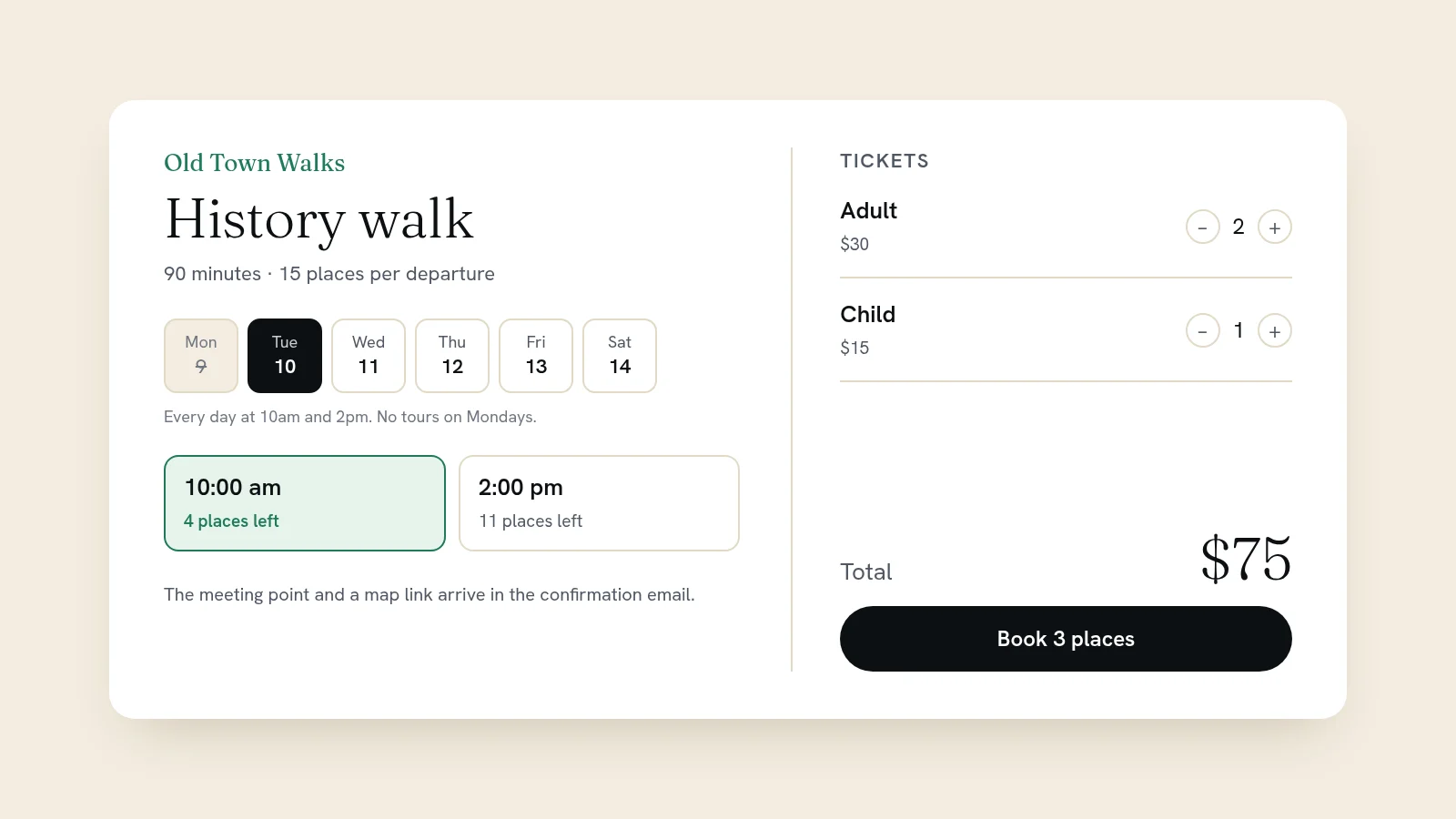
Sell set departures, not "message me for times". Here is a sample setup on a Quick Elements site: a 90-minute history walk at 10am and 2pm every day except Monday, 15 places per departure, an adult ticket at $30 and a child ticket at $15. From there:
- Each tour gets its own page with the route, the meeting point, the length and how far you walk.
- A departure stops selling when its places are gone, and the page shows when only a few are left.
- A private tour is its own booking with one group per slot, so a booked private group closes that time to everyone else.
- Extras can only be bought with a ticket, such as a printed map or a tasting upgrade on a food tour.
- You write a confirmation with the meeting point and a map link, a reminder the day before with your weather plan, and a follow-up asking for a review.
- If you call off a tour for weather, move each booking to another date, or cancel and refund it, from your list of sales. Our guide to writing a weather cancellation policy has wording you can use.
- At the meeting point, check guests in from the departure's list on your phone, found by name.
The tour operator design comes with a guided day hike already set up at $75 a walker, ten places, and pack and poles hire as an extra. Card payments cost 3.99% + 30¢ a sale with processing included, and no commission is taken on top.
Your first tour, this month
This week, walk your route at the time you'll run it and ask your city whether guides need a license. Next week, put two departures on sale for friends and hotel staff at half price. When those run smoothly, open the full calendar. Pick a plan and your first departure can be on sale the same day.