
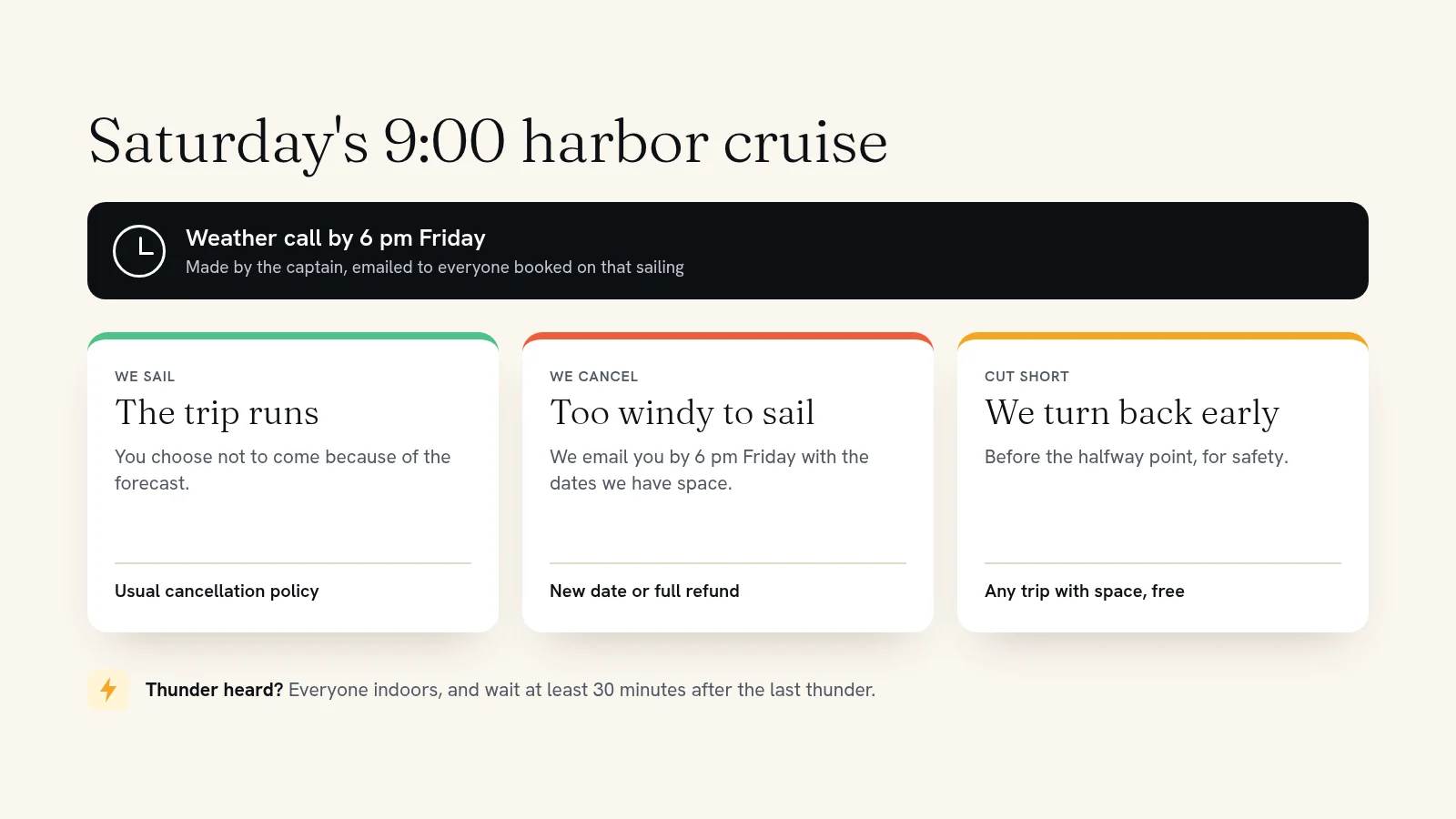
A weather cancellation policy tells customers four things: who decides whether the trip or event goes ahead, by when they'll hear, what kind of weather causes a cancellation, and what they get if it does. The fairest version for tours, boats and outdoor events is simple. If you cancel because of the weather, customers choose a new date or a full refund. If you go ahead and they decide not to come, your usual cancellation policy applies. Decide your weather limits before the season starts, make the call at the same time every time, and tell everyone on that date at once.
Below you'll find what to cover, how to set your limits, wording you can adapt for boat tours, walking tours, outdoor markets, classes and shows, and how to move everyone to a new date without chaos. This is general guidance, not legal advice. Consumer rules on refunds differ between states and countries, so check yours.
What a weather policy should cover
- Who makes the call: you, the captain, the guide. Not the customer.
- When they'll hear: "by 6 pm the evening before", or "at least two hours before departure".
- What weather counts: thunder and lightning, high wind or waves, extreme heat, ice. Say "unsafe conditions" and give examples, rather than promising a number you might need to change.
- What they get if you cancel: a new date, a full refund, or a credit, and who chooses.
- What happens if it's cut short: a free place on another date, a partial refund, or nothing after a certain point.
- What happens if you go ahead and they don't come: usually your normal cancellation policy.
- Whether it's rain or shine: if light rain doesn't stop you, say so loudly.
- What you won't cover: travel, hotels and parking people paid for themselves.
Set your weather limits before the season
Deciding in the moment, with paying customers waiting at the dock, leads to bad calls in both directions. Write your limits down while the sun's out.
Lightning
The US National Weather Service's lightning guidance is blunt: "When thunder roars, go indoors," and there's no safe place outside when thunderstorms are in the area. For organized outdoor activities, its lightning safety advice for sports and outdoor events (checked November 2026) says organizers should consider cancelling or postponing if thunderstorms are forecast, that people should wait at least 30 minutes after the last thunder before going back outside, and that someone should be named to watch the weather, not the person running the activity. It also warns that small structures like rain shelters and sheds aren't safe. Put those rules straight into your plan.
Wind and water
For boats, paddling and anything on the water, set limits for wind speed and wave height that fit your vessel, your license and your customers' experience. The National Weather Service issues small craft advisories for coastal waters and the Great Lakes, and the thresholds that trigger one differ by area, according to its glossary. A practical approach is to treat an advisory for your own waters as the point where you stop and decide, and to set lower limits of your own for open boats and beginners.
Heat, cold and everything else
Walking tours, gardens, outdoor classes and markets have their own limits: extreme heat, icy paths, smoke, flooding. Pick the ones that apply to you, write down what you'll do for each (shorten, move indoors, postpone), and tell your staff.
Make the call the same way every time
- Check the forecast at fixed times: the morning before, and again at your decision time.
- Decide at your published time, even if the forecast is uncertain. A clear "we're postponing" the evening before is kinder than a hopeful "we'll see in the morning".
- If the forecast is borderline, say so and give a second decision time.
- Tell everyone on that date at once, by email and, if you have their numbers, by text.
What to offer when you cancel
A choice of a new date or a full refund is hard to argue with, and it keeps the conversation short. A credit for future use keeps the money in your business, but if you offer only credit, say so before people book, and check that it's allowed where you are. In some places the law may require a refund when the business cancels, whatever your policy says.
For trips cut short, pick a point that's easy to judge. "If we turn back before the halfway point, you can come again free on any date with space" is clearer than a sliding scale of partial refunds.
Weather cancellation policy examples
Change the times and limits to fit, then read each one aloud. If it sounds like a contract, cut it down.
Boat or wildlife tour
Your captain decides whether we sail, based on wind, waves and visibility. If we cancel for weather, we'll tell you by 6 pm the evening before, and you can choose another date or a full refund. If we have to turn back before the halfway point, you're welcome on any other trip with space, free. If we sail and you choose not to come, our usual cancellation policy applies.
Walking or food tour
Tours run rain or shine, so please dress for the weather. We only cancel for unsafe conditions such as thunderstorms, ice or extreme heat. If we do, we'll email you at least two hours before the start, and you can move to another date or get a full refund.
Outdoor market or festival
The market goes ahead in light rain. If we close because of storms or high winds, tickets bought for that day will be refunded in full, or you can use them on our next date. If we have to close partway through the day, we'll announce it on site and on our website, and tickets won't be refunded once the market has been open for two hours.
Outdoor class
If it's raining at 7 am on class day, we'll move inside to the studio and email you by 7:30. If there's thunder in the area, class is cancelled and your place moves to next week, or we'll refund you if you prefer.
Outdoor show or concert
Performances may pause for weather. If thunder is heard, we'll clear the seating area and wait at least 30 minutes after the last thunder before restarting. If the performance is cancelled before the interval, your ticket can be used on another date or refunded. Once the interval has passed, the performance counts as given.
For the rest of your policy, including how much notice to ask for and what late cancellations cost, see how to write a cancellation policy.
When the customer cancels because of the forecast
This is the awkward one: you're sailing, the customer has seen a gloomy forecast and wants their money back. Your policy should already answer it: if you run, your usual cancellation terms apply. You can still be generous. Offering to move them to another date with space, at no charge, costs you little and earns more goodwill than a refund fight.
How to move everyone to a new date
- Open the list of who's booked for that date and time.
- Email them all at once with the decision, the reason, the dates you have space on, and how to choose.
- As replies come in, move each booking to its new date, and refund anyone who asked for their money back.
- Post the news on your website and social accounts for anyone who didn't see the email.
- Follow up the next morning with anyone who hasn't answered.
Subject: Saturday's 9:00 cruise is off because of high winds. Hi Sam, the wind forecast for Saturday morning is above our safe limit, so we won't be sailing. You can move to Sunday at 9:00, next Saturday at 9:00, or any date on our website, or we'll refund you in full. Just reply with what you'd like. Sorry to miss you this weekend.
Weather days on Quick Elements
On a Quick Elements site, every tour or event date has its own list of who's booked, with each customer's name and email, so you know exactly who to contact. From that list you can move a booking to another date and time with space, which frees the old place and takes one on the new date, or cancel it so the place goes back on sale. Moving a booking doesn't email the customer by itself, so tell them in your own message. Refunds, in full or in part, are made from the customer's order.
Put a one-line version of your weather policy in the note that sits above the dates on each booking page, so everyone reads it before they pay. Add it to the confirmation email too, and in your reminder the day before, say when you'll make the weather call. When you call off a date, set its number of places to zero for that date so nobody else books it while you're moving people.
Write your limits and your decision time down this week, before the next bad forecast forces the question. The boat tour design comes with expeditions, places per trip and reminder emails already set up; see how it fits tour and event operators.