
To start teaching cooking classes, you don't need to open a cooking school. You can begin in a rented commercial kitchen, a partner's space or your students' own homes. What you do need is a menu people want to learn, a kitchen your health department accepts for teaching the public, any food safety certificate it requires, liability insurance, a way to find out about allergies before the class, and a price that covers ingredients and kitchen time. Then put your first dates on sale on your own website.
Where you can teach
| Where | Good for | Watch out for |
|---|---|---|
| A rented commercial kitchen | Public classes of 8 to 12 people | Hourly rent, and getting the same slot every week |
| A partner's space: a kitchen shop, a restaurant on its closed day, a community center | Starting without paying rent | Sharing the money, and working around their rules and calendar |
| The client's home | Private classes, birthdays, couples | Kitchens you haven't seen, and carrying everything in |
| Your own home | Small groups, if your local rules allow it | Check first whether they allow it at all |
| Online, live | Students anywhere | Everyone cooks in their own kitchen with what they have |
Commercial kitchens rent by the hour. Call three near you and ask for a four-hour evening slot, including setup and cleaning down. That number goes straight into your class price.
Rules to check before you teach
- Health department. Ask your county or city health department whether a class where students eat what they cook counts as serving food to the public, and what that means for the kitchen you use and any permit you need. The answer differs from place to place.
- Food safety certificates. Some health departments want a food handler card for anyone handling food, or a certified food protection manager on site. Ask which applies to you.
- Allergies. The FDA lists nine major food allergens: milk, eggs, fish, crustacean shellfish, tree nuts, peanuts, wheat, soybeans and sesame (FDA, checked November 2026). Note which of them each dish contains, put it on the class page, and ask every student before the day.
- Alcohol. Serving wine with the meal, or including it in the price, usually needs a license, and letting students bring their own has its own rules. Check with your state's alcohol authority; the federal Alcohol and Tobacco Tax and Trade Bureau keeps a list of them.
- Business license and insurance. A local business license, and general liability insurance. Ask your broker about product liability too, since students eat what you helped them make. Both are in the SBA's guide to business insurance.
This is general information, not legal advice. Check the rules where you'll teach.
Plan a class people book
- Name the result, not the subject. "Fresh pasta from scratch: two shapes and a sauce" tells people what they'll leave able to do; "Italian cooking" doesn't.
- Keep it to two or three dishes in two and a half to three hours, eaten together at the end.
- Set the group size by your stations. Six stations with a pair at each makes twelve places.
- Write the recipes up to hand out or email afterwards.
- Make a prep list and a timing plan, and run the class once for friends before you sell it.
- Once the first class works, add a date-night class, a kids' class and a private group option.
Price your class
Say you teach a three-hour fresh pasta class for up to 12 people at $85 a place. You rent a kitchen for four hours at $40 an hour, pay an assistant $60, and ingredients cost $12 a student. Here it is with 6 places sold and with all 12:
| 6 places sold | 12 places sold | |
|---|---|---|
| Money in | $510.00 | $1,020.00 |
| Kitchen, 4 hours at $40 | $160.00 | $160.00 |
| Assistant | $60.00 | $60.00 |
| Ingredients, $12 a student | $72.00 | $144.00 |
| Card fees, 3.99% + 30¢ a place | $22.15 | $44.30 |
| Left over | $195.85 | $611.70 |
Each student adds about $69 after their ingredients and card fee, so this class covers its $220 of kitchen and assistant at four students. If a date has fewer than four booked a few days out, move them to another date and tell them the same day.
For private classes, charge per group with a minimum, so a booking always covers the kitchen. For help choosing the number itself, read how much to charge for a class.
Get your first students
- Teach a class for friends at cost, and ask for photos and honest notes.
- Offer a demonstration at a farmers market or a kitchen shop, with a card for your next date.
- Pitch team-building classes to local employers for weekday evenings.
- Sell gift cards for a class before the holidays.
- Run a date-night class on Fridays and sell it as a pair.
- Ask each student if they'd like an email when new classes go up, and send one the day next month's dates go on sale.
If you'd rather cook for people than teach them, a supper club is the other way to sell your food by the seat. See how to start a supper club.
Take bookings from day one
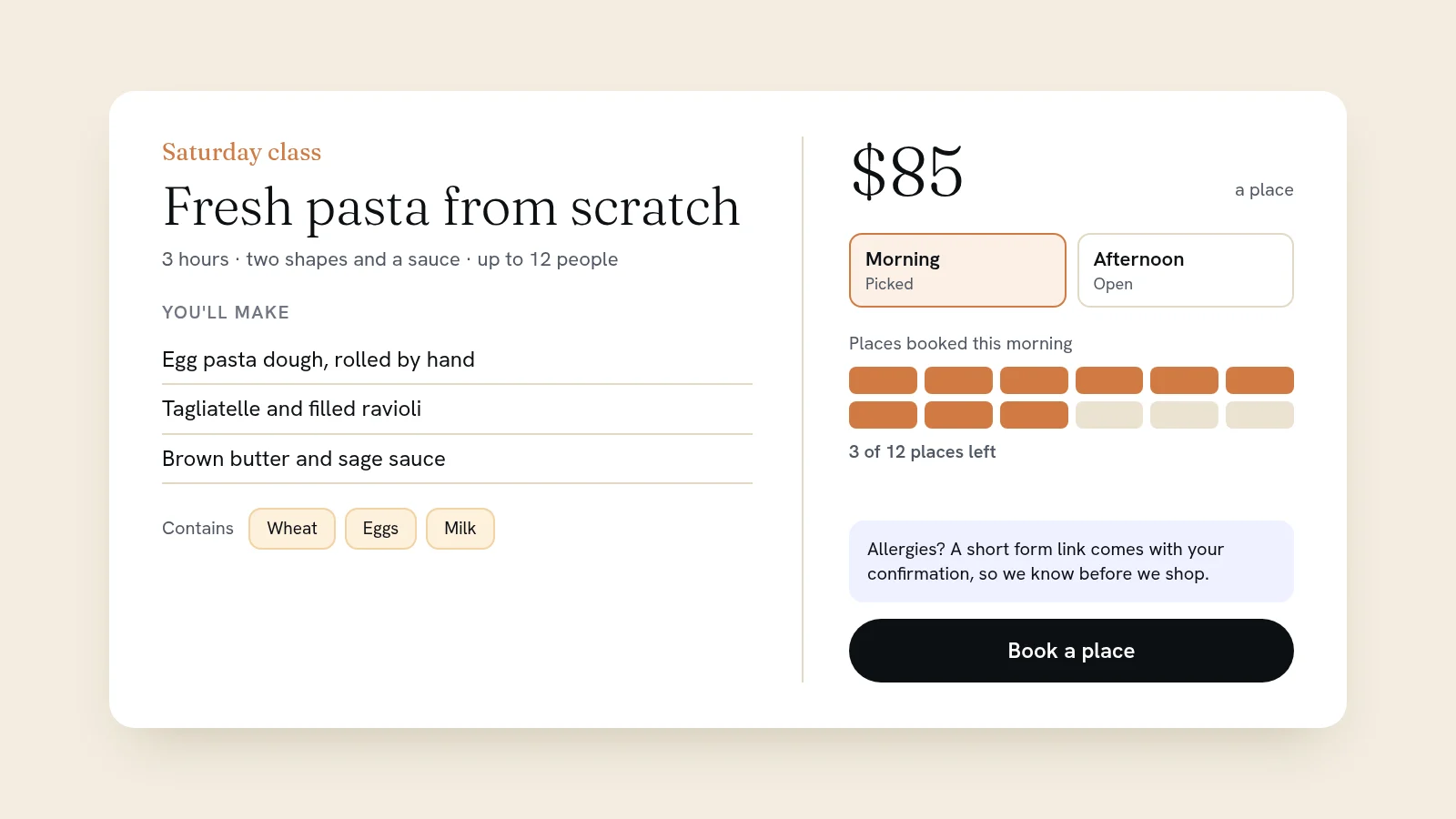
On a Quick Elements site each class gets its own page on your web address, with the menu, the length, what to bring and the places left. The cooking school design comes with a fresh pasta workshop already set up at $85 a place with 12 places, morning and afternoon, a $65 knife skills evening, and an $85 class gift card in its shop.
- Places close at your station count, and the page shows when only a few are left.
- Sell a single place and a date-night pair as different ticket types, plus extras that can only be bought with a place, such as an apron or a take-home spice kit.
- Repeat a class weekly or list one-off dates, with a different price on a holiday date.
- Write a confirmation with what to bring and where to park, a reminder the day before, and a follow-up with the recipes.
- Enter phone bookings by hand, against the same places.
One thing it doesn't do is ask each student your own questions during booking. Build a short allergy form instead, put its link in the confirmation email, and read the answers before you shop. Card payments cost 3.99% + 30¢ a sale with processing included. See how it fits cooking schools.
Your next step
Call your health department this week with one question: can you teach a class where students eat what they cook, and in what kind of kitchen? Then price a kitchen, write one menu and teach it to friends. When it works, pick a plan and put the next date on sale.