To work out how much to charge for a class, add up what one session costs to run (the teacher, the room and your own time), decide how much profit the session should make, and divide both by the number of places you can count on selling, not by the size of the room. Add the materials each person uses and the card fee, and round up to a clean number. Then check that price against similar classes near you. The three worked examples below, for a pottery class, a cooking class and a paint and sip night, show the method with every number on the table.
The method in four steps
- Fixed costs per session. Everything you pay whether two people come or twelve: the teacher (including you, at an hourly rate you'd accept from someone else), setup and clean-down time, a share of rent and utilities, and anything hired in.
- Materials per person. Clay and firing, ingredients, canvas and paint, aprons washed, anything people take home.
- Places you can count on. Not the room's capacity. If you're new, plan on about two-thirds full; once you have a track record, use your real average.
- Profit per session. What makes the class worth running. Decide it up front, so it's in the price rather than whatever happens to be left over.
Then: price = (fixed costs + profit) ÷ places you can count on + materials per person, plus the card fee. On Quick Elements that fee is 3.99% + 30¢ per sale with processing included. Round the result up to a number that looks deliberate.
The numbers in the examples are made up to show the method. Your teacher rates, rent and materials will be different, and they're the only numbers that matter.
Example: a pottery class
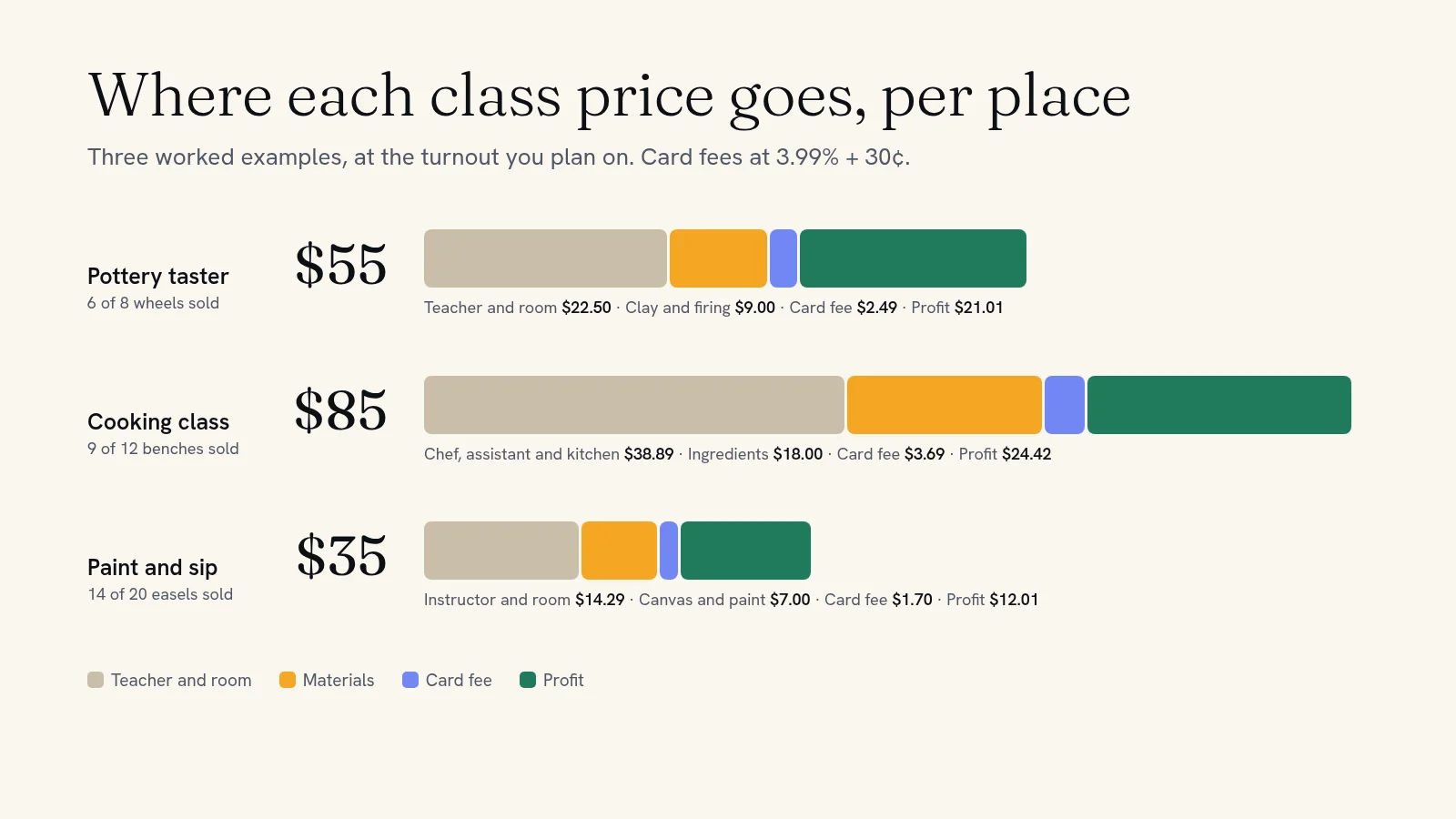
A two-and-a-half-hour wheel-throwing taster with eight wheels. The teacher is paid for three hours to include setup, clay, glaze and firing come to $9 a person, and the class should make $120. Plan on six of the eight wheels.
| Pottery taster | Amount |
|---|---|
| Teacher, 3 hours at $30 | $90.00 |
| Share of rent and kiln power | $45.00 |
| Fixed costs per session | $135.00 |
| Clay, glaze and firing, per person | $9.00 |
| Price the formula gives, with card fee | $53.95 |
| Price, rounded up | $55.00 |
| Card fee per place | $2.49 |
| Places to break even | 4 of 8 |
| Profit with 6 places sold | $126.06 |
| Profit with all 8 sold | $213.08 |
If pieces are glazed and fired later, count the second session's teacher time and the kiln too. It's easy to underprice a taster when the firing happens a week later and never makes it into the sums.
Example: a cooking class
A three-hour hands-on class for twelve, with a chef and an assistant paid for four and a half hours to cover shopping, prep and cleaning. Ingredients are $18 a person, and the class should make $200. Plan on nine of the twelve benches.
| Cooking class | Amount |
|---|---|
| Chef, 4.5 hours at about $45 | $200.00 |
| Assistant, 4.5 hours at $20 | $90.00 |
| Share of kitchen rent and power | $60.00 |
| Fixed costs per session | $350.00 |
| Ingredients, per person | $18.00 |
| Price the formula gives, with card fee | $82.71 |
| Price, rounded up | $85.00 |
| Card fee per place | $3.69 |
| Places to break even | 6 of 12 |
| Profit with 9 places sold | $219.79 |
| Profit with all 12 sold | $409.72 |
Cooking classes carry the most per-person cost, so ingredient prices move your margin more than anything else. Recheck them every season, and price wine or a sit-down meal at the end as its own line rather than hiding it in the class price.
Example: a paint and sip night
A two-and-a-half-hour painting session for twenty, with the instructor paid for three and a half hours including setup. Canvas, paint and brushes come to $7 a person, the room costs $80, and the night should make $150. Plan on fourteen of the twenty easels.
| Paint and sip | Amount |
|---|---|
| Instructor, 3.5 hours at about $35 | $120.00 |
| Room hire | $80.00 |
| Fixed costs per session | $200.00 |
| Canvas, paint and brushes, per person | $7.00 |
| Price the formula gives, with card fee | $33.64 |
| Price, rounded up | $35.00 |
| Card fee per place | $1.70 |
| Places to break even | 8 of 20 |
| Profit with 14 places sold | $168.20 |
| Profit with all 20 sold | $326.00 |
The "sip" changes the sums. Whether guests may bring their own wine, and whether you may serve or sell it, depends on your state, county or city and sometimes on the venue's own license. Check with your local alcohol licensing office before you advertise drinks. If you include them, add their cost per person, and any license or bar staff, to the table. If you're starting out, our guide to starting a paint and sip business covers the rest of the setup.
Check the price against local classes
Your costs set the lowest price you can live with. What people around you pay sets the top. Find five classes like yours nearby and note, for each, the length, the group size, what's included and what people take home. Then compare like with like: a three-hour class with lunch isn't the same product as a ninety-minute demo.
- If your price is in the range, keep it and make the page show exactly what's included.
- If it's above the range, either show why (smaller groups, better materials, a meal, a finished piece fired and glazed) or change the class: shorter, a bigger group, or cheaper materials.
- If it's well below, you're probably leaving money on the table. Raise it before your first class, not after people are used to it.
Don't start a price war. Pricing below everyone else leaves no room to pay a second teacher when you grow.
Other prices worth setting
- Private groups for birthdays, bachelorette parties and team days: a price per person with a minimum, so a group of four can't book out a room for twelve. Our guide to team and corporate bookings covers this in detail.
- Extras such as an extra bag of clay, a take-home apron or a framed canvas, sold alongside the place.
- Weekend and holiday prices a few dollars higher where those dates sell out first.
- Gift cards for your classes, worth promoting before the holidays.
When to raise your class prices
Raise prices when classes sell out more than two weeks ahead for a month or more, when your costs rise, or when you've added something people value. Raise them for newly listed dates and leave existing bookings alone. A few dollars at a time is easier for regulars to accept than one big jump.
Pricing classes on Quick Elements
On a Quick Elements site, each class has its own page and its own price per place, and a limit per booking so one person can't buy out the room. You can set a different price for particular dates, sell a second kind of place, such as a sibling or member place, at its own price, and add extras that can only be bought with a place. Private sessions can carry a minimum per booking. Card sales cost 3.99% + 30¢ each with processing included, and nothing is added to the buyer's total. For setting it all up, see how to sell workshops online.
Take your next class, fill in the table above with your own costs, and see whether today's price clears the profit you want at two-thirds full. If it doesn't, change the price before the next date goes on sale. See how it works for craft studios and cooking schools.