As of November 2026, Mindbody starts at $79 a month per location on its Starter plan in North America. Its Accelerate and Ultimate plans aren't priced publicly; you get those figures on a sales call. On top of the plan, card payments through Mindbody Payments cost a processing rate Mindbody doesn't publish plus 10¢ to 30¢ per transaction, and when the Mindbody app brings you a brand-new client, Mindbody takes 20% of their first purchase, up to $30. There's no setup fee.
So the true cost of Mindbody depends on two numbers you only get from a sales rep. Below is everything Mindbody does publish, what to ask for, and how to tell whether your own website would cost less for a studio your size.
Mindbody plans and prices
| Plan | Price | What it adds |
|---|---|---|
| Starter | From $79 a month per location | Booking, payments, reporting, a website with booking built in, branded booking widgets, a listing on the Mindbody app, unlimited staff logins |
| Accelerate | On request | Room and equipment scheduling, clients choosing their own spot in class, promo codes, advanced analytics |
| Ultimate | On request | Email and text marketing campaigns, an AI front desk for missed calls, a sales pipeline for leads |
Mindbody says discounts are available through its sales team, and that your contract and cancellation terms depend on the plan and billing terms you sign. Read the cancellation notice period before you sign.
The fees on top of the plan
- Card processing through Mindbody Payments: a percentage that varies by card type and by whether the card is present, plus a fixed 10¢ to 30¢ per transaction. Mindbody's pricing page doesn't give the percentage.
- New clients from the Mindbody app: 20% of a new client's first purchase, capped at $30. There's no fee if they're an existing client, came through your own tracked referral link, or say they found you another way. Every booking after the first is free of this fee.
- No onboarding fee on any plan, and no charge for extra staff logins.
Here's what the app fee looks like on common first purchases: a $25 drop-in class costs you $5, a $99 intro month costs $19.80, and a $200 class pack hits the $30 cap.
Source: Mindbody's pricing page and the questions answered on it, checked November 2026.
Is Mindbody cheaper than your own website?
On a Quick Elements site you pay a plan from $29 a month on a yearly plan, and 3.99% + 30¢ per card sale, card processing included. Mindbody's plan costs $50 a month more, but its card rate might be lower than ours. Which way it falls depends on how much you sell.
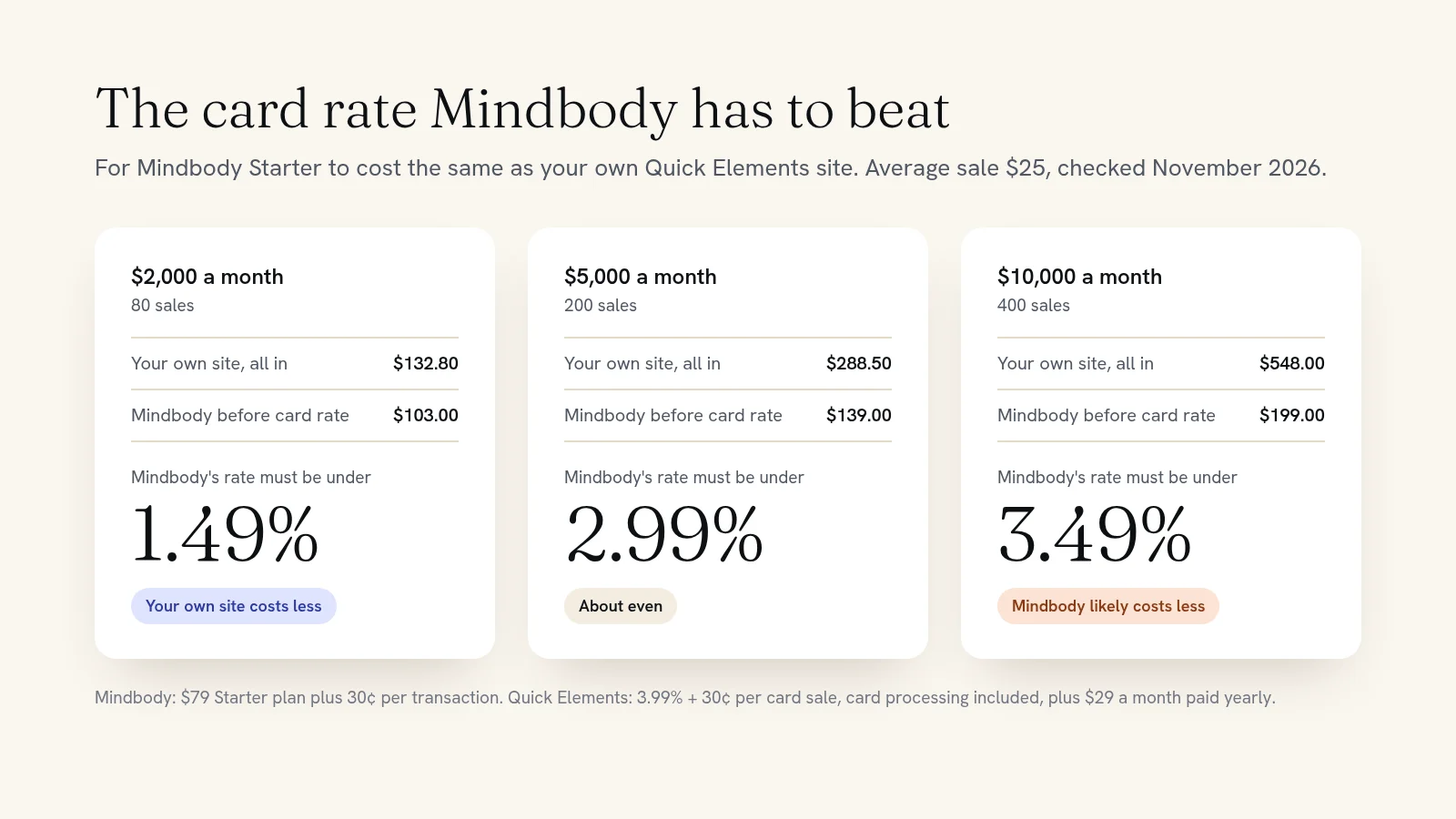
The table works out, for three sizes of studio, what Mindbody's card percentage would have to be for its Starter plan to cost the same as your own site. It assumes an average sale of $25 and Mindbody's highest fixed fee of 30¢.
| Sales a month | Your own Quick Elements site, all in | Mindbody Starter before its card percentage | Mindbody matches your own site if its card rate is |
|---|---|---|---|
| $2,000 (80 sales) | $132.80 | $103.00 | 1.49% |
| $5,000 (200 sales) | $288.50 | $139.00 | 2.99% |
| $10,000 (400 sales) | $548.00 | $199.00 | 3.49% |
Card rates for online payments are rarely as low as 1.49%, so a small studio taking around $2,000 a month almost certainly pays less on its own site. Around $5,000 a month the two are close. At $10,000 a month, Mindbody Starter is likely cheaper on fees, unless its rate for you is above 3.49% or you need Accelerate or Ultimate. Ask Mindbody for your online card rate in writing, then find your row.
Who Mindbody suits
Mindbody does several things a Quick Elements site doesn't, and for some studios they decide it:
- Memberships tied to the class schedule. Members book without paying each time, and visits are counted. On a Quick Elements site you can sell a plan that renews itself in your shop, but it isn't connected to booking, so members still book each place.
- A marketplace. The Mindbody app lists your classes to people searching nearby. We have no marketplace.
- A team and several locations, with unlimited staff logins and multi-location tools.
- Clients picking their own spot in class, on Accelerate.
If you're one studio selling drop-ins, class packs, workshops and a few products, those matter less. Our Mindbody alternative page goes through the differences one by one, and Mindbody vs Vagaro covers the other big name.
What classes on your own site look like
Each class is set once with its times on each weekday, and the dates fill themselves in. You set how many places each class has, and classes sharing a room share its limit, so the last mat can't be sold twice. Days you're closed come off the schedule. Students get a confirmation when they book, a reminder before class, and a follow-up if you want one. Walk-ins go in by hand as cash, card or check. See it finished in the yoga studio design, and read how to sell class passes and memberships online for what works today.
Studios also ask about ClassPass, which belongs to the same parent company as Mindbody. We've written up how ClassPass pays studios separately.
Get your two numbers
Before any demo, write down your monthly card sales and how many transactions they came from. In the call, ask for two things in writing: your plan price and your online card rate. Put them next to the table above. If your own site comes out ahead, compare our plans and keep Mindbody running until your new schedule is live.