ClassPass doesn't publish how much it pays studios per visit. As of November 2026, its partner FAQ says only that ClassPass "often pays a lower per-spot rate than a direct booking". The payout is set studio by studio: you agree a confidential minimum with ClassPass, worked out as a percentage of your own direct price, and ClassPass's pricing tool then moves each spot's price above that minimum depending on demand. Listing costs nothing and there's no monthly fee. In return, every fitness partner has to give one free first class to people on a ClassPass trial, and payouts arrive every two weeks or monthly, depending on your agreement.
So nobody outside your contract can tell you your rate. Below is how ClassPass sets it, when you're paid nothing and when you're paid for a no-show, and how to work out whether it's worth it for your studio.
How ClassPass decides what it pays
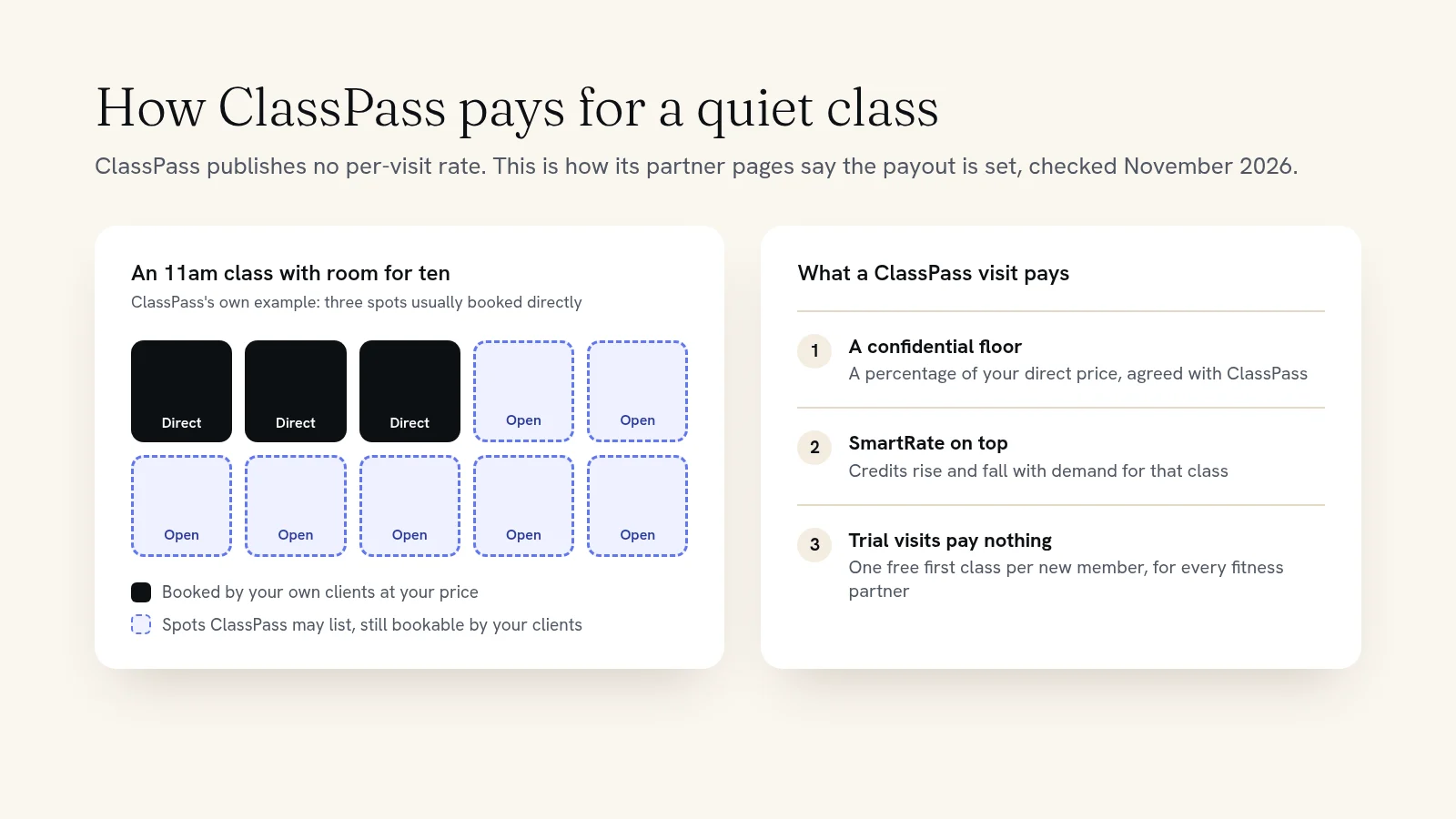
- A confidential floor. ClassPass agrees a minimum with each partner, based on a percentage of the studio's direct pricing. Every paid reservation pays at least that.
- SmartRate on top. Members book with credits, not dollars. ClassPass's SmartRate tool raises or lowers how many credits a spot costs, using how full that class usually gets, how popular it is, how full it is now and how close it is to starting. ClassPass says this is meant to earn you as much as possible per spot.
- Not based on the member. ClassPass says payouts don't drop because a particular member visits you often. Rates follow demand for the class, not one person's habits.
- SmartSpot decides which spots are listed. It looks at your past attendance and current bookings and only lists spots it predicts you won't sell yourself. A listed spot can still be booked by your own clients.
- Paid by direct deposit, every two weeks or monthly, depending on your agreement.
Sources: ClassPass's partner FAQ, its how it works page for businesses and its partner page, checked November 2026. Payout figures you may see on forums or review sites aren't from ClassPass and vary by studio, so we've left them out.
When you're paid nothing, and when you're paid for a no-show
- Trial visits are free. All fitness partners must take part in the ClassPass trial: one free class per business for each new member during their trial. People who come back to ClassPass after a year away from your studio can get another. You aren't paid for these visits. ClassPass says only spots likely to go unsold are offered to trial users.
- Late cancellations and no-shows are usually paid. ClassPass uses a 12-hour late cancellation window for every partner. A member who cancels inside it, or doesn't turn up, normally still earns you a payout, unless you've told ClassPass you allow cancellations up to the last minute.
- One spot, one payment. If another ClassPass member takes the late-cancelled spot, you're paid once, for the new booking. If one of your own clients fills it, the late cancel payout is dropped.
Is ClassPass worth it for a studio?
It depends on two numbers only you can know: how many spots you leave empty, and how many of your regulars would rather book through ClassPass. ClassPass's own example is a quiet 11am class with room for ten that usually gets three direct bookings. The seven empty mats earn nothing on their own, so anything ClassPass pays for them is money you wouldn't otherwise have had. Your rent, your teacher and your heating cost the same either way.
The risk runs the other way. Say your drop-in is $28, and say, purely as an example, your ClassPass payout works out at $14. Every empty mat ClassPass fills earns you $14. Every regular who stops paying you $28 and books you through ClassPass instead costs you $14. If one regular switches for every ClassPass visit you'd never have had, you've gained nothing.
ClassPass itself says it isn't a good fit for:
- Studios that reliably sell out every spot, because there's nothing spare to list.
- Struggling studios looking for a quick turnaround. It says studios with strong direct demand do better on it.
- Workouts people can easily do at home.
- Areas where few people use ClassPass.
It also says plainly that ClassPass "isn't designed to drive direct client conversions". Its members are, in its words, younger, more price-sensitive and looking for variety. You may ask them to join your email list, but ClassPass asks you not to target them with offers your existing clients don't get. If you join and it doesn't work for you, you can leave after a 90-day opt-out window.
ClassPass belongs to the same parent company as Mindbody, and it offers Mindbody customers a guarantee: if ClassPass revenue in your first 90 days is less than the direct revenue you lose, it pays you twice the difference, with terms attached. If you're weighing Mindbody too, see what Mindbody costs.
Filling quiet classes yourself
ClassPass brings people who've never heard of you, and nothing on your own website replaces that reach. You can use both. What your own site can do is sell the classes people already want at your full price, and fill some of the quiet ones without a marketplace in between.
On a Quick Elements site you pay 3.99% + 30¢ per card sale, card processing included, so a $28 drop-in leaves you $26.58. You can set a lower price on chosen dates, so the 11am class costs less than the 6pm, or send your newsletter a discount code that only works on quiet classes. Class packs can be sold in your shop, and our guide to selling class passes and memberships online explains how studios handle them today, including what isn't automatic. For ideas that bring people in on quiet days, see yoga studio workshop ideas, and the yoga studio design shows a weekly timetable with places per class.
Before you sign up
Count the empty spots in each class over the last four weeks, and note which classes are usually full. Ask ClassPass, in writing, for your rate floor, your payout schedule and how the trial visits will work at your studio. If most of your spare capacity sits in a few quiet slots, try filling those yourself first with a weekday price on your own site, then decide whether ClassPass should have the rest. Our plans start at $29 a month on a yearly plan.