
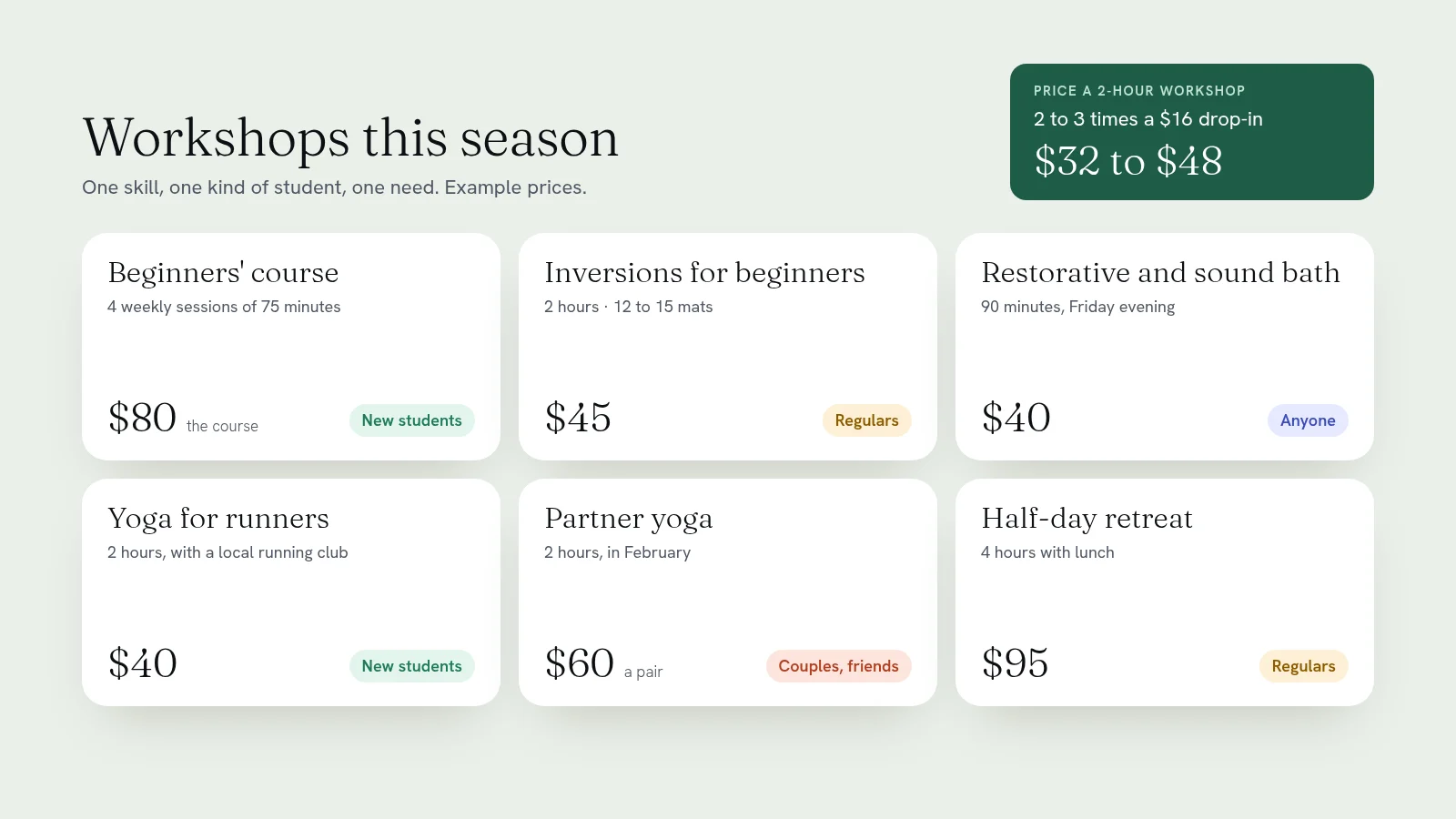
The yoga workshops that sell are specific: one skill, one kind of student or one need, such as "Inversions for beginners", "Yoga for runners" or "Restorative and sound bath". Run them for two to three hours at a time your regular classes don't use, price them at roughly two to three times your drop-in rate, cap them at the mats your room holds, and offer them to your own students before anyone else. A four-week beginners' course is the workshop most studios should run first, because it turns newcomers into regulars.
Below are twelve ideas with an example length and price, then how to plan a year of them and sell them.
Yoga workshop ideas at a glance
| Workshop | Length | Example price | Who it's for |
|---|---|---|---|
| Beginners' course | 4 weekly sessions of 75 minutes | $80 for the course | Complete beginners |
| Inversions for beginners | 2 hours | $45 | Regulars who want to go upside down safely |
| Arm balances | 2 hours | $45 | Confident regulars |
| Restorative and sound bath | 90 minutes, Friday evening | $40 | Anyone who needs to slow down |
| Yoga for runners | 2 hours | $40 | A local running club |
| Yin and meditation | 2 hours | $40 | People who want a slower practice |
| Breathwork | 90 minutes | $35 | Students curious about the breath |
| Partner yoga | 2 hours | $60 a pair | Couples and friends |
| Prenatal series | 6 weekly sessions | $110 for the series | Expecting parents |
| Chair yoga | 60 minutes, weekday morning | $12 | Older adults and anyone who can't get to the floor |
| Family yoga | 45 minutes, Saturday morning | $25 a family | Kids with a grown-up |
| Half-day retreat | 4 hours with lunch | $95 | Regulars who want a reset |
Workshops that bring in new students
Beginners' course
Four weeks, same night, same small group, building from the basics. Newcomers are nervous about walking into a full class; a course where everyone is new removes that. End the last session with an offer for your intro pass, and most of the group has a reason to stay.
Yoga for runners (or cyclists, climbers, golfers)
Pick a local sport, partner with its club, and run a workshop on the stretches and strength that sport needs. The club promotes it to its members, many of whom might never have walked into a yoga studio otherwise.
Chair yoga
A gentle weekday class on chairs, for older adults or anyone who finds the floor hard. It fills the mid-morning hours when the studio is usually empty, and word of mouth does the marketing.
Family yoga
Short, playful and priced per family, on a Saturday morning. Parents who enjoy it start asking about adult classes.
Workshops your regulars will pay extra for
Inversions and arm balances
The poses people are scared of trying in a busy class. Two hours lets a teacher break them down step by step, with spotting and props. Cap these lower than a normal class, at 12 to 15 mats, so everyone gets attention.
Restorative and sound bath
A Friday evening of long supported poses, with a sound practitioner if you can find one. It sells on its own as a night out, and it sells well as a gift.
Yin, meditation and breathwork
Slower practices that many students want to understand better but rarely get time for in a regular class. Run them as stand-alone workshops, or as a three-part series across a month.
Half-day retreat
A morning of practice, a simple lunch and an afternoon session, without leaving town. It gives regulars a taste of a retreat at a fraction of the cost, and it tells you whether a weekend away would sell.
Series and special groups
A prenatal series needs a teacher with prenatal training, and it's wise to ask each student to check with their doctor or midwife before joining; say so on the page. Partner yoga is the natural February workshop, priced per pair; our list of Valentine's Day event ideas has more for that month. And if you train teachers, anatomy and sequencing workshops for qualified teachers are a market of their own.
Plan a year of workshops
- January: a beginners' course and a new-year intentions workshop, for the people who've just made a resolution.
- February: partner yoga.
- Spring: inversions and arm balances, when regulars feel strong.
- Summer: yoga for runners, and outdoor sessions if you have the space.
- Autumn: restorative, yin and breathwork, as the evenings draw in.
- December: a half-day retreat, and workshop gift cards for Christmas.
One workshop a month is plenty for most studios. More than that and they start competing with each other for the same students.
Pricing and guest teachers
A simple starting point: price a two-hour workshop at two to three times your drop-in rate, which is $32 to $48 if your drop-in is $16. Then check it covers the teacher, the room and any extras with a third of the mats empty. Our guide to how much to charge for a class walks through the sums. If a guest teacher leads it, agree their fee or share of each ticket before you set the price, and agree who promotes it to whom.
Give members a lower price, such as 20% off, so membership keeps paying for itself. Set a minimum to run, three or four people, and say on the page what happens if it isn't met.
Sell workshops on your own site
On a Quick Elements site, each workshop gets its own page with the date, what it covers, who it's for, the price and the mats left:
- Set the number of places to your mats, and the most per booking.
- For a course, sell the place on the first date and list all the dates on the page. The people booked on that first date are your course list.
- Give members a discount code that only works with their email address, and an early-booking code that ends on a set date.
- Add extras people can only buy with a place: mat hire, an eye pillow, tea afterwards.
- Send a confirmation with what to bring and a reminder the day before.
- Sell workshop gift cards in the same shop as your class packs.
Card payments cost 3.99% + 30¢ per sale, card processing included. The yoga studio design comes with a weekly timetable, a $16 drop-in, a ten-class pack and a two-week intro pass already set up, so a workshop page sits right beside them. For the step-by-step on filling the last places, see our guide to selling workshops online.
Pick your first workshop
Ask your teachers which pose or topic students ask about most after class, and make that the first workshop. Put it on sale six weeks out, tell your students before anyone else, and see how fast it fills. See more on how studios use it at yoga studios.