
To start a pottery studio, find a space that can take an electric kiln (the power, the vent and the clearance around it), buy a small set of wheels and one kiln, insure the business, and open with taster classes and short courses before you sell memberships. Classes bring money in from the first week; a membership community takes months to build. Check the zoning, the building's electrics and your landlord's consent before you sign a lease, because the kiln is what most often rules a space out.
Decide what kind of studio you're opening
A pottery studio can earn from any mix of these:
- Taster classes: one or two hours on the wheel for complete beginners. Easy to sell, and easy to give as a present.
- Courses: four to eight weekly sessions that take someone from centering to glazing.
- Memberships: experienced potters pay monthly for wheel time, shelf space and firing.
- Firing fees, charged by the kiln load or by the size of a piece.
- Private parties and team events.
- Your own work, sold in the studio and online.
A class-led studio fills its calendar sooner. A membership studio needs a community before it pays, and more shelves and kiln space per person, because members make more pots. Starting with classes, and adding members as students finish their courses and want to keep going, is the lower-risk order.
Find a space that can take a kiln
Walk through any space with this list before you talk about rent:
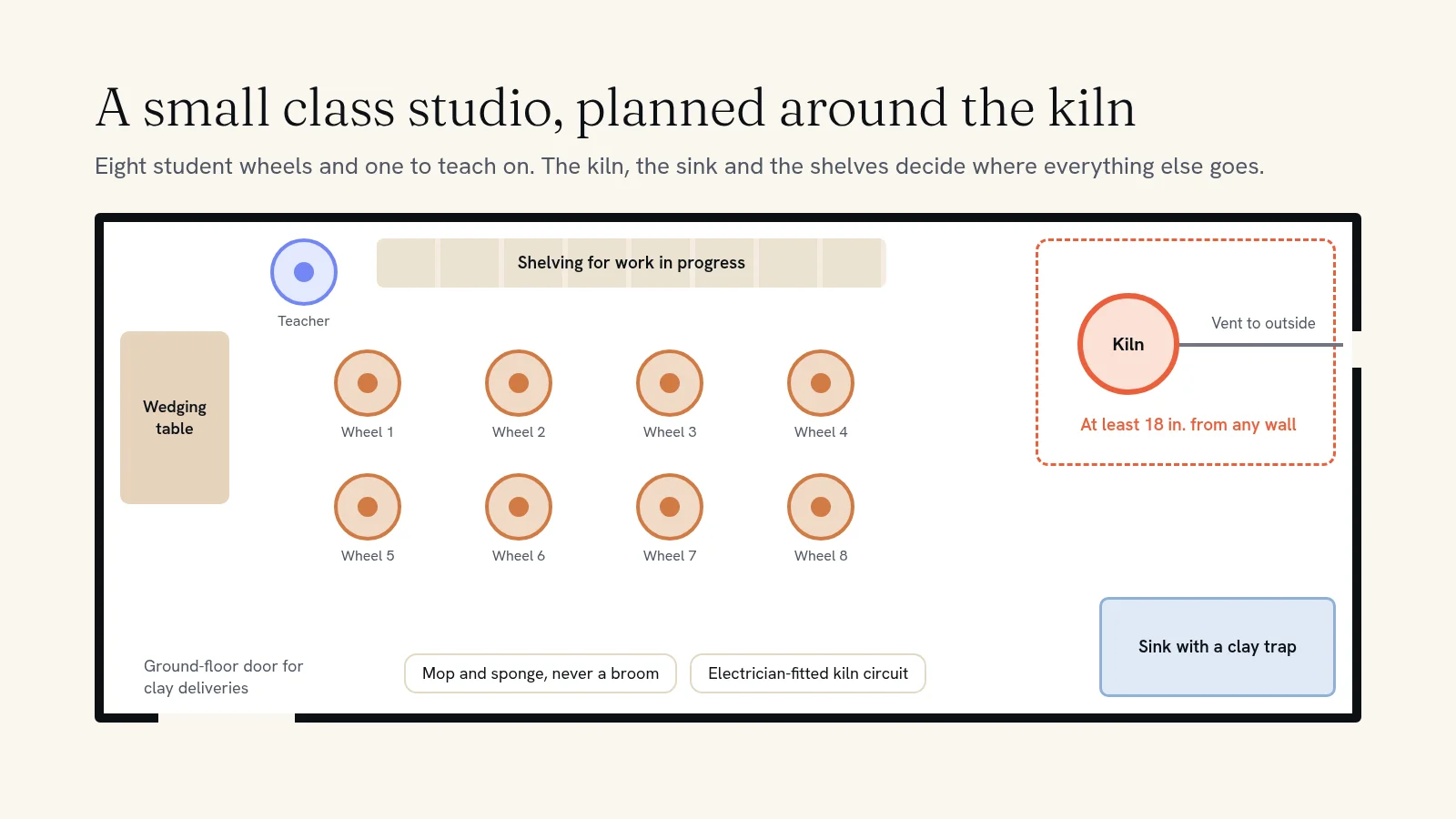
- Power. A studio-size electric kiln plugs into a receptacle an electrician installs to match its plug. Skutt, a kiln maker, tells buyers to have an electrician check whether the building supplies 208 or 240 volts, because the kiln has to match (Skutt's installation guidance, checked November 2026). Ask the electrician to price a dedicated circuit to the spot where the kiln will stand.
- Clearance and air. Skutt suggests kilns stand at least 18 inches from any wall, and describes a vent that ducts fumes from the kiln to a fan on the wall. Firing gives off heat and fumes, so the kiln usually needs its own corner or room.
- Water. Sinks for washing up, with a clay trap or settling buckets so clay never goes down the drain, where it settles and blocks pipes.
- Floors and deliveries. A floor you can mop, and a ground-floor door, because clay arrives by the box or the pallet and it's heavy.
- Permission. Zoning that allows a kiln and classes, and a lease that says so. Ask your fire department whether it wants to inspect the kiln installation.
Keep the clay dust down
Dry clay and glaze dust contain crystalline silica. OSHA lists making ceramic products among the ways people are exposed to it, and links breathing it to silicosis, lung cancer and other diseases (OSHA, checked November 2026). Build the habits in from the first day: clean with water, a mop and a sponge rather than a broom; reclaim scraps while they're wet; and keep food and drink out of the work area. Once you take on staff, OSHA's rules for employers apply, so read its silica pages and ask your insurer what they expect.
What it costs to set up
Kilns and wheels vary so much by size and brand that a single figure would mislead you. Price each line for the studio you're planning:
| Line | How to estimate it |
|---|---|
| Electric kiln | Count the pieces a full week of classes makes, and price two kilns that can fire them |
| Kiln vent and electrical work | An electrician's quote for the circuit and receptacle, plus the vent |
| Kiln shelves and posts | Enough for a full load |
| Wheels | One per student in your largest class, plus one to teach on |
| Wedging table, shelving and boards | Shelf space for every piece in progress from every class |
| Tools, buckets, bats and aprons | A starter set per wheel |
| Clay and glaze | Track what your first course uses, then order in bulk |
| Sinks and clay trap | A plumber's quote |
| Insurance and licenses | A broker's quote, and your city and state |
| Website and booking | A monthly plan, plus a fee on each card sale |
| Rent and deposit | Usually the biggest monthly cost |
For insurance, the SBA's list of common business insurance is a good checklist to take to a broker: general liability for injuries and damage, commercial property for the kiln and wheels, and product liability if you sell work you make. This is general information, not legal advice, so check the rules where you are.
Price courses and memberships
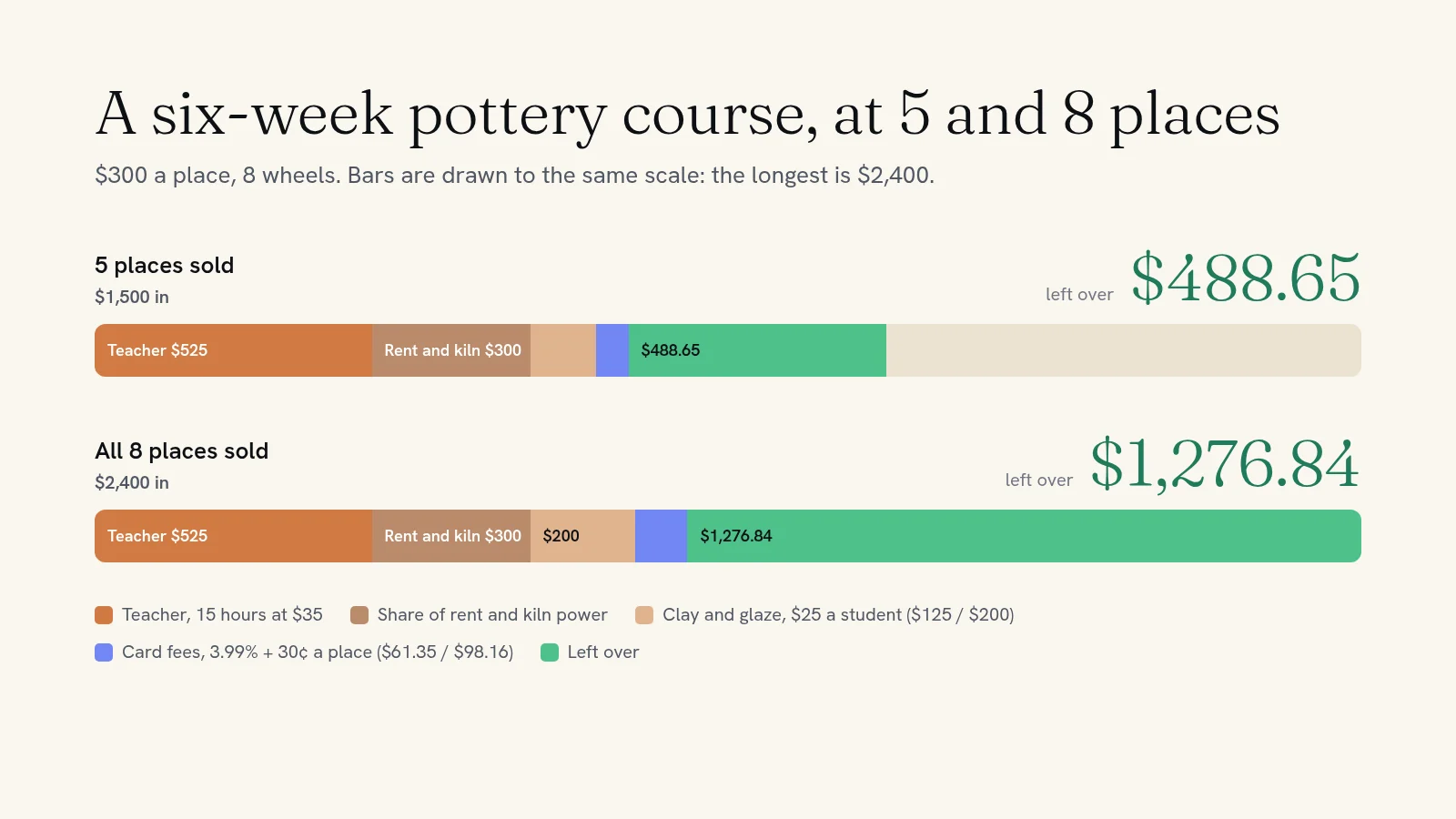
Take a six-week beginner course with 8 wheels at $300 a place. The teacher is paid $35 an hour for six sessions of two and a half hours, clay and glaze cost $25 a student, and the course's share of rent and kiln power is $300. Here it is with 5 places sold and with all 8:
| 5 places sold | 8 places sold | |
|---|---|---|
| Money in | $1,500.00 | $2,400.00 |
| Teacher, 15 hours at $35 | $525.00 | $525.00 |
| Share of rent and kiln power | $300.00 | $300.00 |
| Clay and glaze, $25 a student | $125.00 | $200.00 |
| Card fees, 3.99% + 30¢ a place | $61.35 | $98.16 |
| Left over | $488.65 | $1,276.84 |
Each place adds about $262 after its clay and card fee, so the course covers its $825 of fixed costs at four places.
For memberships, start from what a member uses: wheel hours, a shelf and kiln space. Set a monthly price that covers those at the number of members your shelves can hold, and charge firing separately if some members fire far more than others. Don't sell more memberships than your kiln can fire in a week. A backlog of unfired pots loses members faster than a price rise. Our guide to selling class passes and memberships shows how to set the steps from a single class up to unlimited.
Get your first students
- Open with taster classes. They're the easiest thing to sell, and the keenest people from each one become your course students.
- Sell tasters for two as a date night or a night out with a friend.
- Sell gift cards in November and December.
- Post short videos of the work: centering, trimming, opening the kiln.
- Take a stall at local markets with your own pots and a sign for the next taster.
- Offer team events to local employers on weekday afternoons, when the wheels are free.
Our guide to selling workshops online covers writing the class page and filling the last places.
Take bookings from day one
On a Quick Elements site each taster, course and open studio session gets its own page on your web address, with places capped at your wheel count. The pottery studio design comes with a $55 wheel-throwing taster with eight wheels, three times a day, and a $22 open studio session with twelve bench places, so you change the details rather than start from a blank page.
- Repeat tasters weekly on the days you choose, with days off for holidays and kiln maintenance.
- Sell a six-week course as one booking on its first date, with every session date listed on the page.
- Sell memberships as monthly plans that renew and charge the member's card until they cancel.
- Sell firing fees, glaze sets and gift cards in the same shop.
- Write a confirmation that says what to wear (clothes that can get clay on them), a reminder the day before, and a follow-up timed for when pieces are usually ready to collect.
Card payments cost 3.99% + 30¢ a sale with card processing included, on every plan.
Your next step
Before you look at another space, ask an electrician to walk the one you like best with you and price the kiln circuit and vent. If the building can take a kiln, put a taster date on sale for friends and family and see how fast it fills. See how studio sites work on our page for craft studios.