To start a paint and sip business, you need a place to paint (your own studio, or pop-up nights at bars, breweries and wineries), an artist who can take a room of beginners through one painting in about two and a half hours, easels and supplies for 12 to 20 people, liability insurance, and a clear answer from your state on alcohol. Running pop-ups first is a cheap way to test demand before you sign a lease. Price each seat so a class covers its costs at about a quarter full, and put your first dates on sale on your own website three or four weeks ahead.
Choose how you'll run it
There are three common ways in, and the one you pick decides most of your costs.
- Pop-ups at other venues. You bring the easels and the lesson. A bar, brewery, winery or restaurant brings the room and sells drinks under its own license. You pay no rent, need no alcohol license of your own, and the venue gets a busy weeknight. Agree in writing who sells the tickets, what the venue is paid (a room fee or a share of each ticket), and who cleans up.
- Your own studio. A room you control, with classes most nights, private parties at weekends and kids' sessions in the mornings. You carry the rent, so you need a full calendar.
- A franchise. A known name, ready-made paintings and a playbook, in return for an upfront fee and ongoing royalties. The franchisor must give you its Franchise Disclosure Document at least 14 days before you sign or pay anything, and items 5 to 7 set out the fees, according to the FTC's guide to buying a franchise (checked November 2026).
Pop-ups are the cheapest way to learn what sells in your town. Run six or eight, watch which paintings and which nights fill, and you'll know whether a studio would.
Check the alcohol rules before you say "sip"
The "sip" is the part most likely to get you in trouble, and the rules change from state to state and sometimes from city to city. There are three usual setups:
- Guests bring their own wine. Some places allow this at a business with no license, some need a permit, and some don't allow it at all.
- Drinks are included in the ticket or sold by you. In most places that counts as selling alcohol and needs a license.
- A licensed venue sells the drinks. This is how pop-ups at bars and wineries work, and the license stays theirs.
Ask your state's alcohol agency which applies to you before you advertise anything. The federal Alcohol and Tobacco Tax and Trade Bureau keeps a list of every state's alcohol authority and notes that state laws "vary widely from state to state". Ask your landlord and your insurer too, since a lease or a policy can rule out alcohol where the law allows it. If the answer is no, a paint night with coffee and mocktails still sells, and so do kids' and family sessions.
Licenses and insurance
Beyond alcohol, a paint and sip business needs what most small businesses need: a registered business name, a local business license, and a sales tax registration if you sell kits or merchandise. The SBA's guide to licenses and permits suggests starting with your Secretary of State's website, then your city and county. A studio may also need a fire inspection for the number of people you'll have in the room.
For insurance, ask a broker about general liability, which covers injuries and damage your business causes, and commercial property for your easels and stock. Both are on the SBA's list of common business insurance. If guests drink at your classes, ask specifically about liquor liability, because a general policy may not include it. Pop-up venues may ask to see your certificate before your first night.
This is general information, not legal advice. Rules differ by state and city, so check yours.
What it costs to start
Easels, canvas and paint vary a lot in price by supplier and by how many you buy, so instead of trusting an average, price each of these lines from two suppliers for the number of seats you plan:
| Line | How to estimate it |
|---|---|
| Tabletop easels | One per seat, two spares, and one for the teacher |
| Canvases | One per guest per class, priced per canvas from a bulk pack |
| Paint, brushes, palettes, water cups | A starter set for your seat count, then the reorder you need every few weeks |
| Aprons and table covers | One apron per seat; covers either reusable or replaced each class |
| Tables and chairs | Only for a studio. Pop-up venues have their own |
| Transport | For pop-ups, crates and a vehicle that takes every easel in one trip |
| Licenses and insurance | Quotes from your city, your state and a broker |
| Website and booking | A monthly plan, plus a fee on each card sale |
| Studio rent and deposit | Only if you take a lease, and usually the biggest line by far |
Then work out your supplies cost per guest: the canvas, plus the paint and brushes used up, spread across the classes one set lasts. That number goes into your seat price.
Price each seat so a class pays
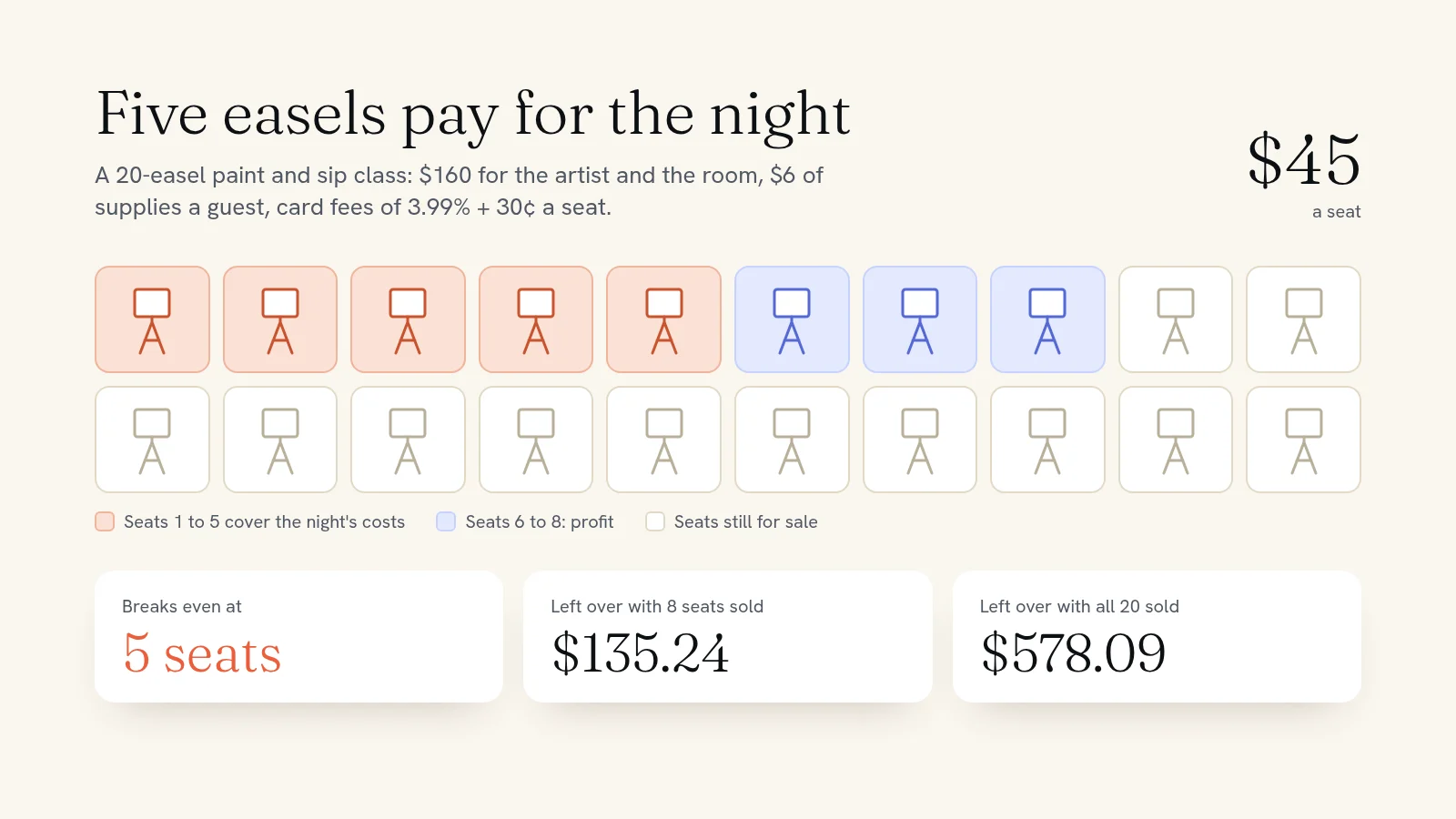
Say you run a two-and-a-half-hour class with 20 easels at $45 a seat. The artist is paid $100 for the night, the room costs $60 (your share of rent, or a pop-up venue's fee), and supplies come to $6 a guest. Here is one class with 8 seats sold and with all 20:
| 8 seats sold | 20 seats sold | |
|---|---|---|
| Money in | $360.00 | $900.00 |
| Artist for the night | $100.00 | $100.00 |
| Room | $60.00 | $60.00 |
| Canvas and paint, $6 a guest | $48.00 | $120.00 |
| Card fees, 3.99% + 30¢ a seat | $16.76 | $41.91 |
| Left over | $135.24 | $578.09 |
Each seat adds about $36.90 once its supplies and card fee are paid, so this class covers its $160 of fixed costs at five seats. That's the number to watch. If a date has fewer than five booked a few days out, move those guests to another night, or offer the slot to a private party.
Two more prices to set before you open:
- Private parties. A price per painter with a minimum group, such as 10, so a booked party always covers the night. Take the full amount when they book, or a deposit that comes off the total.
- Date night. A ticket for two at a little under the price of two seats. A pair is one sale, so you pay one card fee instead of two.
For more on setting the number itself, see how much to charge for a class.
Choose paintings people want to hang
The painting is what people buy. They choose the night by the picture, so:
- Design your own paintings, or pay an artist for designs you're allowed to teach. Copying a living artist's work, or another studio's, invites trouble.
- Pick something a nervous beginner can finish in the time: a bold silhouette, a sunset, a simple landscape, one big flower.
- Paint the sample yourself, step by step, and time each step. Then allow extra, because a room of beginners works slower than you do.
- Photograph the finished sample in good light. That photo sells the class.
- Keep a mix: a seasonal painting, a pair for couples that hangs side by side, a pet portrait night, and kids' versions of your most popular ones.
Get your first customers
- Run a preview night for friends at a lower price, and ask everyone to post their painting.
- Pitch pop-ups to two or three bars, breweries or wineries for their quiet nights. Take the sample painting and a date. Our list of bar event ideas for slow nights shows why a venue says yes.
- Sell private parties: birthdays, bachelorettes and team nights. One booked party fills a whole evening.
- List your studio on Google with photos of finished paintings, and ask happy guests for reviews.
- Sell gift cards from November. They bring in people who would never have found you on their own.
- Ask everyone who books whether they'd like your monthly email, and send the new month's paintings on the first.
Take bookings on your own site from day one
Don't take bookings by message. Every seat should be booked and paid online, so you know the count before you load the car. On a Quick Elements site:
- Every painting gets its own page with the photo, date, length, what's included and your drinks rule, and visitors can filter your class list by date night, kids or beginners.
- Set the places to your easel count. The page shows when only a few are left and stops selling when the last one goes.
- Sell a single seat and a date-night pair as separate ticket types, each with its own price and limit, and add extras that can only be bought with a seat, such as an apron to take home.
- Charge more on a Saturday date and less on a quiet Tuesday for the same class.
- Run private parties as their own class with a minimum group and one group per time slot, so a booked party closes the room.
- Write a confirmation email with the address, parking and drinks rule, a reminder the day before, and a follow-up asking for a photo of their painting.
- Enter walk-ins and phone bookings by hand, as cash, card or check, against the same easel count.
Two things it doesn't do: there's no waitlist that refills a cancelled seat by itself, and you can't ask each guest your own questions during booking. If you need names or allergies for a party, put a link to a short form in the confirmation email. Card payments cost 3.99% + 30¢ a sale with processing included, and there's no per-ticket fee.
Your first week
Call your state alcohol agency, paint two sample paintings and time every step, and ask one bar or winery for a quiet weeknight. Then put that night on sale. Our page for paint and sip studios shows how a studio site looks and books, and you can pick a plan once the first date is set.