
Timed entry tickets give every visitor an arrival time instead of an open day pass. To set them up, decide how many people your site holds comfortably at once and how long the average visit lasts, split the day into entry slots of 15 to 30 minutes, and sell a fixed number of tickets per slot. Then write down your rules for late arrivals, members and walk-ups before the first ticket sells. It works for gardens, museums, galleries, planetariums, light trails, corn mazes and any seasonal attraction that gets crowded at the same hours every week.
When timed entry makes sense
Timed entry spreads a crowd across the day. It's worth the extra step for your visitors when:
- The place gets uncomfortable at peak times, or a fire or safety limit caps how many can be inside.
- Queues at the gate are long enough that people complain about them.
- A season is short and every slot is precious, such as a holiday light show or a pumpkin patch in October.
- The experience is a show or session with a start time, such as a planetarium show or a guided tour.
If you rarely get close to full, a simple dated ticket with no time is easier for everyone. You can always add times for your busiest weekends only.
How many tickets to sell per slot
For a visit people can stay at as long as they like, use this:
Tickets per slot = people you can hold at once × slot length ÷ average visit length
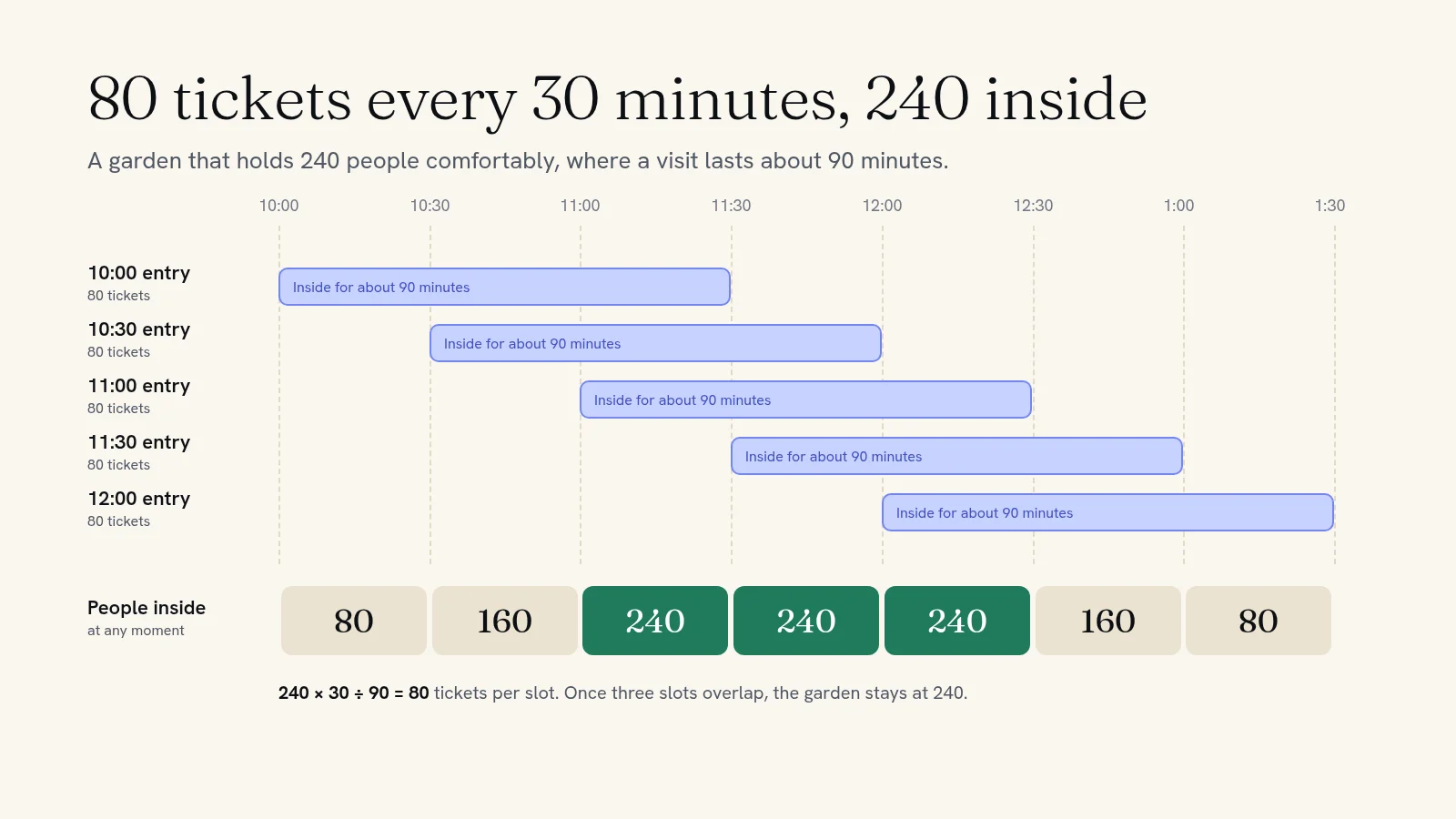
Say a garden holds 240 people comfortably, visits last about 90 minutes, and you open a slot every 30 minutes. That's 240 × 30 ÷ 90 = 80 tickets per slot. Three slots' worth of visitors are inside at any moment once the day gets going, which is 240.
| Slot length | Tickets per slot | People arriving together |
|---|---|---|
| 15 minutes | 40 | A steady trickle; short gate queues |
| 30 minutes | 80 | The usual choice for gardens and museums |
| 60 minutes | 160 | Simpler to run, but bigger rushes at the gate |
Don't guess the visit length. On a busy day, note the time on a few dozen tickets at the gate and again as those people leave, and take the average. Then sell slightly fewer than the formula gives, around 10% fewer, to leave room for members, people who stay longer and walk-ups. You can raise it once you've watched a few busy days.
For a show or session with a fixed start, like a planetarium show or a lantern walk, it's simpler: tickets per slot equals the seats or places, and the slots are spaced by the length of the show plus the time it takes to empty and refill.
Arrival windows and late arrivals
Print the rule on the ticket page and in the confirmation email, and make it an arrival window rather than an exact time: "Your ticket is for entry between 10:00 and 10:30. Stay as long as you like." People relax when they know they have half an hour.
For people who arrive after their window, pick one rule and keep it for every visitor:
- Let them in if there's room. The friendliest option where people wander at their own pace. Staff check whether the current slot has space.
- Move them to the next slot with space. Fair to everyone already inside, and easy to explain at the gate.
- No late entry once a show starts. Necessary for seated shows and tours. Say so in bold on the page, with how early to arrive.
Whatever you choose, give staff the authority to be generous when a traffic jam made a whole carload late.
Members, children and carers
Anyone who takes up space should hold a ticket for a slot, even when they pay nothing. Otherwise your count is wrong on exactly the days it matters.
- Members book a free member ticket for their slot and show their card at the gate. If you'd rather nobody else could pick it, give members a discount code that only works with their email address.
- Young children who go free get a free ticket, so they still count against the slot.
- Carers of disabled visitors get a free carer ticket, with a line on the page saying who it's for.
- School and group visits are easier as their own bookable session, outside your busiest public hours.
Walk-ups and the day itself
Decide what happens to people who turn up without booking, such as families on a whim. Either hold back part of each slot from online sale or let online booking run right up to each slot and sell whatever's left at the gate. Every gate sale must come out of the same count as the online ones, or you'll sell the same space twice.
On a sold-out day, put a sign at the entrance and a line at the top of your website before people set off. A wasted trip makes for an angry review.
Pricing timed tickets
The simplest choice is one price for every time, letting the good slots sell first. If your weekends sell out weeks ahead while weekday mornings sit half empty, a higher weekend price or a cheaper early slot moves some visitors to the quiet times. Change one thing at a time, and watch what happens for a few weeks before changing anything else.
Setting up timed entry on Quick Elements
On a Quick Elements site, timed entry is an ordinary bookable event with several start times a day. For the garden above:
- Create the entry as a repeating schedule on your opening days, with a time slot every 30 minutes. Add your closed days and private bookings as days off.
- Add a ticket type for each kind of visitor, each with its own price: adult, child, a free under-five ticket, a free member ticket.
- Put all of them in one shared capacity of 80, so a slot closes at 80 people whatever mix of adults, children and members books it.
- Write the arrival window in the note that sits above the dates, so everyone reads it before they pick a time.
- Write a confirmation email with the window, the late-arrival rule and parking, and a reminder the day before.
Each slot's page shows when only a few places are left and stops selling when it's full. Online booking for a slot stays open until its start time. Gate sales go in by hand as cash or card and come out of the same 80, so the website never sells space you've already sold at the gate. If you need to change a slot's price or its number of places, say for an opening weekend or a members-only morning, you can do it for that date alone.
Our gallery design already works this way: four entry times a day, Wednesday to Sunday, with $18 general admission and $10 under-16 tickets. Card sales cost 3.99% + 30¢ each with processing included, and no fee is added to your visitor's total.
To start, time thirty visits on your next busy day and work out your number per slot. Then see how seasonal attractions run their tickets on Quick Elements, or read how to stop gate and online sales overlapping.