
The bookstore events that work best give people a reason to come in at a set time and leave with a book: author readings and signings, book clubs, kids' story time, writing workshops, quiet reading nights, launch parties and literary trivia. Tie each one to a purchase, such as a ticket that comes off the price of the book or a discount on the club's pick. Keep regular events free, and sell tickets for the ones with a guest, a cost or a small room.
Here are twelve, with how each works, what to charge and what it needs.
Events with authors
1. Author reading and signing
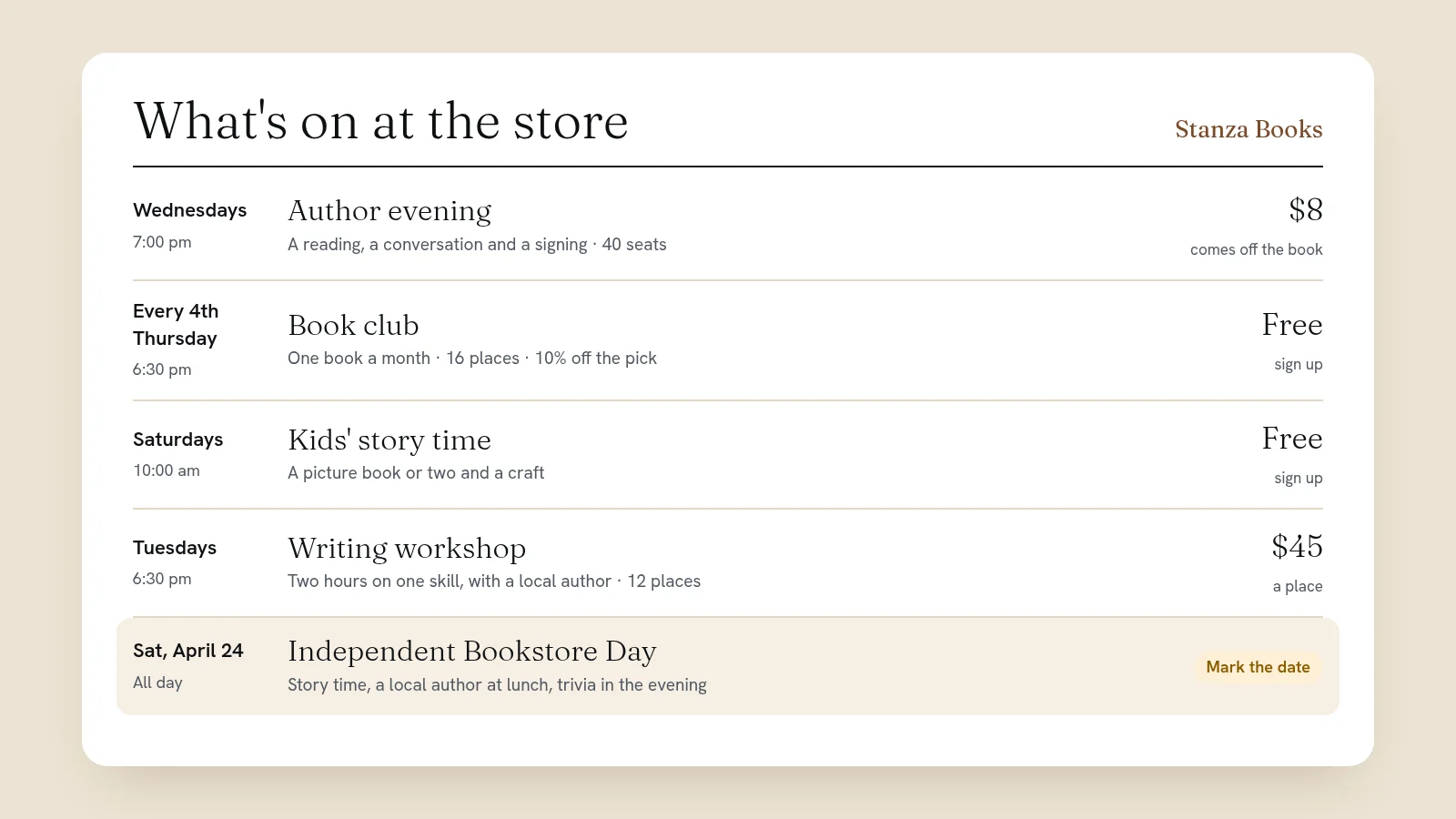
A reading, a conversation with a bookseller or a local writer, questions from the room, then a signing. Charge a small ticket that comes off the price of the book on the night: the bookstore design we ship sells an author evening at $8 a seat, redeemable against the book, with wine and 40 seats. For a bigger name, sell a ticket that includes a copy. Ask the publisher's publicity team early; they often set up the tour and can tell you how many books to order. Take orders for signed copies from people who can't come.
2. A launch party for a local author
Local authors bring their own crowd: family, friends, colleagues and everyone who's waited for the book. Keep it free with sign-up, so you know how many chairs and copies you need. The author does the inviting; you do the selling.
3. A dinner with an author
Partner with a restaurant nearby for a ticketed dinner, with the author talking between courses and a copy of the book at every place. Price the ticket to cover the meal, the book and your share. It's a bigger evening to organize, so try it once a season with an author who has a following.
Regular nights that build regulars
4. Book club
One book a month, discussed properly. Keep it free and give members a discount on the pick: the bookstore design runs one every fourth Thursday with 16 free places and 10% off the book. Once one club is full, start a second by genre (crime, sci-fi, translated fiction) rather than letting one get too big to talk in.
5. A quiet reading night
People bring whatever they're reading and read together for an hour, then talk if they want to. It's free, needs only chairs and a quiet corner, and suits people who'd never join a club with homework. Many will buy their next book on the way out.
6. Kids' story time
A picture book or two and a small craft, every Saturday morning. Free, with a cap of 15 or 20 children so it stays manageable, and sign-ups so parents know they'll get in. The grown-ups browse while the kids listen.
7. Literary trivia
Teams, six rounds, a picture round of book covers, and a book voucher for the winners. It works in a bookstore with room to clear the tables, or at a bar down the road. Our guide to hosting a trivia night has the format and scoring.
8. Poetry open mic
Two poems each, a host and a mic. Free to enter, and it brings in writers who buy poetry and journals. See our guide to running an open mic night.
Paid workshops and appointments
9. Writing workshop
A local author or teacher runs a two-hour session on one skill: openings, dialogue, writing about family, getting published. Charge per session, $45 a place for example, with 12 places, and pay the teacher a set fee or a share of each ticket. A four-week course sells to the people who come back after the first one.
10. Personal book shopping appointments
Twenty minutes with a bookseller who picks books for someone after a few questions about what they love. Free to book, and the customer leaves holding the books you picked for them. It's especially useful from November to Christmas, when people are buying for readers they don't understand.
Seasonal days
11. Independent Bookstore Day
In the US, the American Booksellers Association runs Independent Bookstore Day on the last Saturday in April; the next one is Saturday, April 24, 2027 (ABA, checked November 2026). Plan a full day of small events around it: story time in the morning, a local author at lunch, trivia in the evening.
12. Blind date with a book
Wrap books in brown paper with three clues written on the front, and sell them through February, in the shop and online. It needs no space and no guest, just a bookseller's afternoon. Our list of Valentine's Day event ideas has more for February.
Make every event sell books
- Put the featured book by the door and at the till on the night.
- Take orders for signed copies before an author event, for people who can't come.
- Let a ticket's price come off the book, so the ticket feels like a deposit, not a charge.
- Email everyone who came the next morning with the next event and a link to the book.
Put your events on your own site
On a Quick Elements site, each event gets its own page on your web address, and your events list and monthly calendar fill themselves in:
- Sell author evenings with a ticket price and a set number of seats; the page shows when few are left.
- Take free sign-ups for book clubs and story time, with a cap, repeating every Saturday or every fourth Thursday.
- Offer personal shopping as appointments with set times, free to book.
- Sell signed copies, blind dates and gift cards in the same shop, and give club members a discount code for the pick.
- Write the confirmation and reminder emails yourself, and send a monthly newsletter of what's on.
Free events cost nothing to run. Ticket sales cost 3.99% + 30¢ per card sale, with card processing included. The bookstore design comes with the author evening and the book club above already set up, ready for your own dates. In December, our guide to selling gift cards online is worth a read too.
Plan your next season
Pick one regular free night and one paid event a month, and put both on your calendar for the next three months. Then ask your publisher reps which authors are touring near you this spring.